Andrew Bowes Malcom (1819-1895) and Elspeth Dall (1822-1907) were the parents of my paternal gg grandmother Janet Malcolm. Andrew grew up in Kettle, Fife, Scotland and Elspeth in nearby Balmerino. Andrew and Elspeth married on November 20, 1842, in Collessie, Fife, Scotland. They had both grown up in Fife, Andrew in Kettle and Elspeth in nearby Balmerino.
Between 1843 and 1867 Andrew and Elspeth had twelve children, two of whom died in infancy.
They started their married life when Andrew was 23 and Elspeth 20, in Collessie where Andrew worked as a linen weaver. By 1855 they had moved to Leslie where they lived until Andrew’s death in 1895. Leslie was a village and parish at the middle of the western border of Fife. The main industries were spinning, bleaching and paper milling and Andrew worked in all of them. He was working in the papermill at the age of 72 and possibly until his death at age 76.
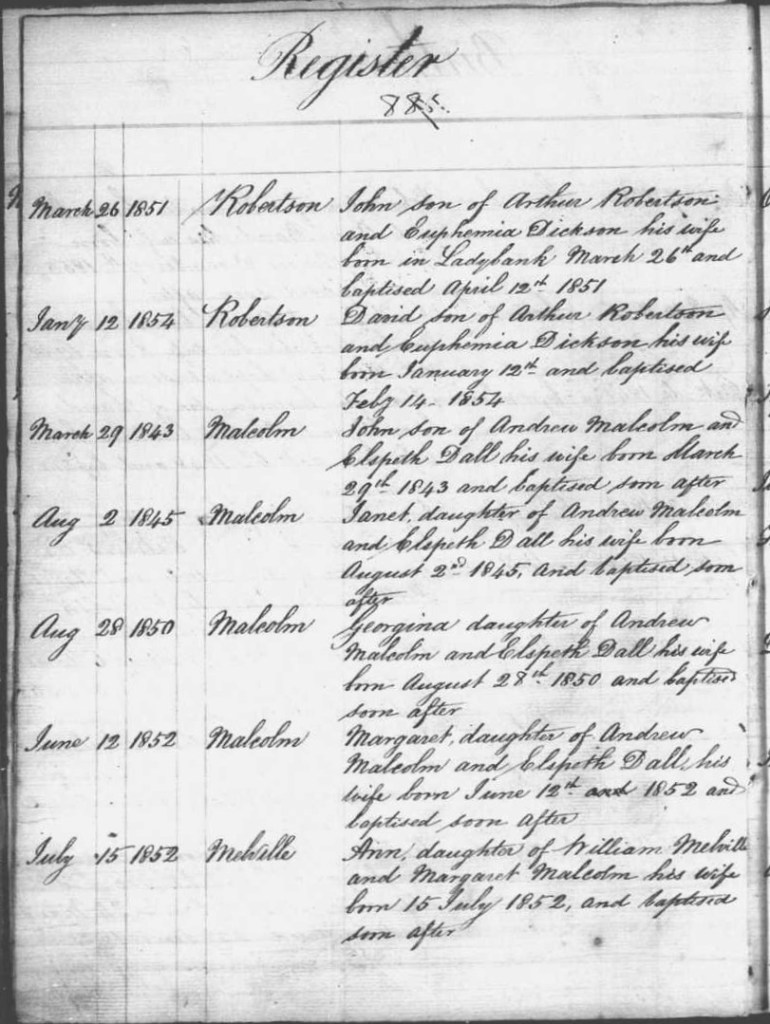
On 1 January 1855 civil birth, marriage, and death registration began in Scotland and became compulsory. Prior to this, these events were registered with the local parish, and often as not parents didn’t bother to register births or registered them in bulk at a later date. Andrew and Elspeth seem to have done this and the first four born before 1855 are registered together with the parish of Collessie. Possibly just before they moved from Collessie to Leslie. It is noted that every child was baptised soon after birth, so I am slightly puzzled as to why they weren’t registered then. The subsequent children are all recorded on the civil register.
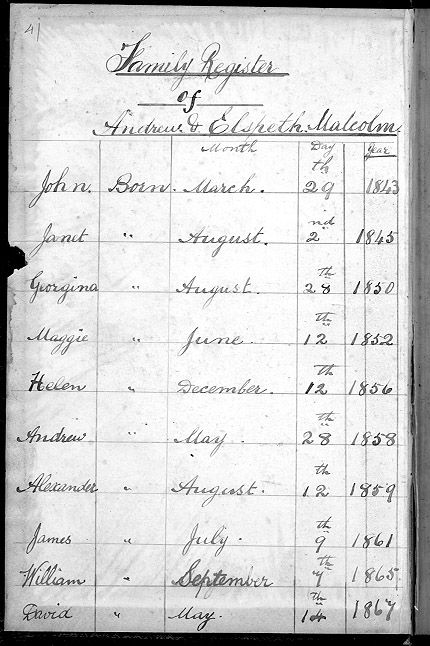
In March 1896 Elspeth recorded the births of all her living children in the Malcolm family bible.
The first born, John, was born in Collessie in 1843. In 1866 he married Catherine Walker in Monimail. John and Catherine had five children and they moved around quite a bit between Fife and the historic county of Angus. The children were all born in different towns. In 1871 John was an iron ship builder in St Andrew, Angus (now Fife). In 1879 they emigrated to Canada with their five children and John died in Winnipeg in 1909, aged 66.
Janet (Jessie), my gg grandmother, was born in Collessie in 1845. At the age of 16 she was working in the cotton mill. At 22 she married William Shepherd Myles, a shoemaker from Cupar. Janet and William moved between Cupar and St Andrews and St Leonards, then to North Leith across the Firth of Forth. In 1886 they settled in Dysart, where they lived until William died in 1895 aged 53. Janet was living with her son George in Glasgow when she died in 1915 aged 69.
Georgina was born in Collessie in 1850. Apparently, it was common in Scottish families, to bestow a boy’s name on a girl and add ina on the end, for example Thomasina, Georgina, Hughina, Jamesina, Williamina. I know someone from Aberdeen who is named Davidina. On leaving school, Georgina worked as in the flax mill in Leslie until her marriage to Alexander Strachan in 1871. She and Alexander had four children. Georgina died in Windygates in 1939, aged 89.
Margaret (Maggie) was born in Collessie in 1852. She also worked in the flax mill in Leslie. In 1874 she married Charles Burgess, and they had nine children. Margaret died in Edinburgh hospital from Bright’s disease in 1903, aged 50.
Elisabeth, born in Leslie in 1855 died in her first year.
Helen was born in Leslie 1856. She worked in the flax mill from the age of twelve until her marriage aged 25 to Peter Donaldson. At the time of the marriage Peter worked at the paper mill where Helen’s father, Andrew worked. Peter’s father worked at the flax mill. Helen and Peter lived in Leuchars and had two children. Helen died in 1941 aged 85.
Andrew was born in Leslie in 1858. He worked in the flax mill from about the age of twelve and married Elizabeth Laverock in Leslie in 1882. During that year they moved to Darwen in Lancashire where Andrew found work in the papermill. Darwen is a market town in “the Blackburn with Darwen” borough in Lancashire. The residents of the town are known as “Darreners”. In the 1890s the cotton industry collapsed in Scotland, primarily because it was cheaper to manufacture cotton in Lancashire where they paid lower wages. After the first world war the cotton industry also collapsed in Lancashire and workers again had to look for alternate occupations. Andrew and Elizabeth had three children. Andrew died in Darwen in 1947, aged 88.
Alexander Malcom was born in Leslie in 1859. He worked in the flax mill and at age 24 married Agnes Clark. They moved to Auchtermuchty where he worked as a joiner and patternmaker. Alexander and Agnes had three children, one of whom, Alexander, worked in as an engineer in Shanghai. In February 1942 he was killed while he was travelling for business on the SS Redang when it was sunk by the Japanese off East Coast of Sumatra. Alexander snr died in Auchtermuchty in 1935, aged 75.
James was born in Leslie in 1861 and he too worked in the flax mill. By 1891 he was working in a damask factory in Dunfermline and boarding with the Muir family. Later that year he married the Muir’s oldest daughter, Martha and they had one child. James worked in the damask factory until the end of his working life and died in in Dunfermline in 1941, aged 80.
The second Elizabeth, born in 1864, died in her third year from jaundice.
William was born in Leslie in 1865. He did a painter’s apprenticeship in Leslie but by 1899 he had moved to Manchester where he married Jessie Martin and they had two children, one of whom died in infancy. He initially worked as a copper stamp maker. Copper stamps were used to imprint makers mark on textiles, so he was probably working in a cotton mill.
By 1911 William had a completely different occupation. He became an insurance agent and by 1939 had retired to Denbighshire in Wales. He and Jessie both died in Leicester, in the late 1940s. Their surviving son William was an insurance agent in Leicester at the time of their deaths. Interestingly William died in Denbighshire, Wales in 1972. I haven’t yet established the Welsh connection.
David, the youngest was born in Leslie in 1867. At 14 he was a railway parcel deliverer in Leslie. At 21 he married Mary King in Leuchars where he worked at the papermill. In 1911 he was listed on the census as a poacherman at the papermill. A poacher was the large drum used for washing and bleaching the paper pulp in the mill. David and Mary had nine children, 8 of whom survived. In the 1911 census they were living in a 3 roomed house with their eight children and the natural son of their eldest, Mary. And they somehow managed to squeeze in a visitor on census night.
From October 1916 to April 1922 David was employed as a dockyard labourer at the Rosyth naval dockyard. He earned about 24 shillings a week. He was terminated in 1922 due to reduction of staff in the dockyards. In 1921 the family were living in Kirkcaldy with their three younger children and four grandchildren. Daughter Mary, the mother of the oldest grandchild had married a widower 20 years her senior and had left her son with her parents. It’s unclear who were the parents of the other three grandchildren. It feels as this may have been a tough time for David and Mary. It’s quite a way from Kirkcaldy to Rosyth. There was a train, but I imagine it was a very long working day for David. He died in Kirkcaldy in 1843 aged 76.
This was a time of real change as Scotland moved from the pre-industrial into the industrial age. There was the rise of the factories and then the decline of the factories as Scotland was unable to compete with the lower wages paid in the north of England. Life doesn’t feel easy for this family. Initially there was ongoing work in the factories and Andrew found local employment all his working life. It seemed a bit harder for his children who mostly moved away from Leslie. They had large families in small houses. The thing that struck me was that they survived. If children lived to adulthood, most of them went on to have long lives, living well into their 70s and 80s. Very different from the lives of the generation earlier.
 Our Folk Stories