From New Zealand Herald, vol LIV, issue 16481, 6th March 1917
Mr John McDonald of Jersey Park, Waipipi, Waiuku can be justly proud of the record his sons are putting up in defence of the empire. His eldest son, Ernest, aged 35, a married man with a wife and four children, left with one of the earliest reinforcements as captain of the 16th Waikatos, and was wounded at the landing on Gallipoli in the shoulder and lung. He was invalided home and, making a rapid recovery, was able to leave New Zealand again as major. At present he is in charge of troops at Sling camp. Elvyn, aged 32, left sometime later, and the latest news shows him to be in the firing line “somewhere in France”. Ronald, 29 years old, left with one of the reinforcement drafts for the Rifle Brigade, was wounded in France, was sent to hospital, recovered, and returned to the front in time to take part in the Somme advance. In December last Ronald was again wounded in the ear and face. The latest news states that he is “making good progress”. Another son, Harold was not twenty when he left New Zealand. He took part in several sharp engagements in Egypt and came through safely. Then he met his brother Ernest, who arrange[d] for his transfer, and he was taken on to the English camp. Mr McDonald’s father, the late Mr Peter McDonald, saw active service in the Maori war, where, whilst serving under Colonel Nixon in the Waikato Mounted Constabulary, he was severely wounded. A nephew of Mr John McDonald also went through the Gallipoli campaign and is now serving in Egypt.
John McDonald was born in Auckland in 1858. He was the only child of Peter McDonald, born in Scotland, and Dorcas Walters, born in Cornwall. Peter McDonald migrated to Auckland, New Zealand from Strathpeffer, in the Scottish Highlands, in the early 1850s. He worked as a blacksmith in Auckland city and married Dorcas Walters at the Wesleyan church on High St in 1857. Dorcas was born in 1838 in St Austell, Cornwall and her family migrated first to NSW, Australia in 1838 and then to Auckland, New Zealand, around 1848. Dorcas died in 1861, when John was three years old, and she is buried in the Symonds St Cemetery. In 1864 Peter married Margaret Collins at St Patrick’s Cathedral on Wyndham St. They had three children in Auckland before moving to Bega, Australia where they had seven more. It was in Bega that John learned the craft of cheesemaking. In 1880 John married Charlotte Latimer, who was born in Surrey Hills in 1853. Her family had emigrated to Australia, from Ireland, in 1838. John and Charlotte had seven children in Bega and around 1896 they emigrated to New Zealand with their six surviving children and settled in the Franklin district. John worked as a cheesemaker at Awhitu, Pollock and Otaua and later farmed at Jersey Park, Waipipi. John sold Jersey Park to the NZ government and it was allocated to his son Ronnie when he returned from war, under the soldier settlement scheme. John’s four sons served in Europe and North Africa during the 1914-18 war. Charlotte died in 1933 and John in 1944 and they are both buried at the Kohekohe cemetery.
Alfred Ernest McDonald 1881-1963
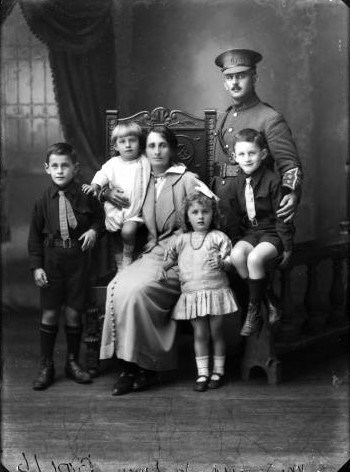
Alfred Ernest, known as Ernie, was born on 7 March 1881 at Bega, NSW, Australia. He was 15 when John and Charlotte moved their family to New Zealand in 1896. In 1907 Ernie married Phoebe Cranston and they had three children, Athol (1908), Ian (1909) and Avis (1912), before Ernie enlisted in the army. Ernie and Phoebe were living in Hamilton where Ernie worked as a commercial traveller. Their fourth son, Colin, was born in 1914 while Ernie was on active service.
10 April 1914-8 February 1918
Auckland Infantry Regiment, 1st Battalion
Service number 12/805
Ernie enlisted on 10 April 1914 and was assigned to the Auckland Infantry Regiment, First Battalion. He embarked with the rank of Captain, 16 October 1914 on HMNZT 8 or 12, on the Star of India or Waimana. He fought in the Gallipoli campaign and was wounded on 29 April. He was transferred to the 15th General Hospital in Alexandria and from there to New Zealand, where he convalesced until May 1916. On 6 May 1916 he again set off for Europe on HMNZT 53 Navua now ranked as Major. He spent the rest of the war in Europe and was discharged on 8 February 1918.
More about Ernie in the war
Auckland War Memorial Online Cenotaph record
Auckland Regiment Unit Diary April 1915
Elvyn Arthur McDonald 1883-1917
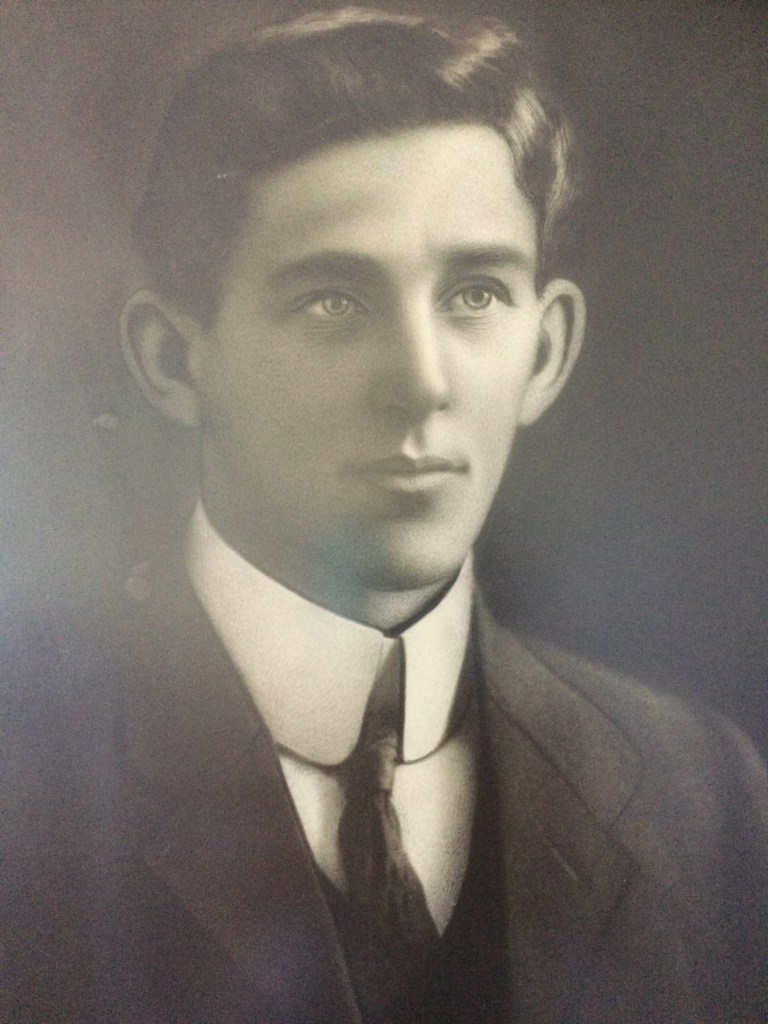
Elvyn was born on 24 November 1883 at Bega, New South Wales, Australia. He was 13 when he emigrated to New Zealand with his family. He worked as a farm labourer for a Mr Hosking at Otaua prior to enlisting to fight.
7 February 1916 – 21 February 1917
Auckland Infantry Battalion, A Company
Service number 24035
Elvyn enlisted on 7 February 1916 and attested at Trentham on 9 February. He was assigned to the Auckland Infantry Battalion, A Company. He embarked as Private on 31 May 1916 aboard HMNZT 54 Willochra. The transport ship docked at HMNB Devonport, Plymouth, England on 26 July and he spent six weeks training at the Sling Camp on the Salisbury Plain. On 5 September 1916 the Battalion was shipped to Etaples, Pas-de-Calais, France, where Elvyn was assigned to 2nd Battalion, Auckland Regiment. The battalion travelled, mostly on foot, from Etaples to Fleurbaix. Elvyn was declared missing following a battle at Fleurbaix on the morning of 21 February 1917. A Court of Enquiry found on 30 April that there was no evidence that he had been taken prisoner and on 5 August he was declared Killed in Action, although his body had not been recovered. Seven years later, in 1924, John received notification that Elvyn’s body had been found and identified from his uniform and papers. He was reinterred in the Pont-du-Hem Military Cemetery, in France and his medals were dispatched to his sister Dorcas in Waiuku.
From The Auckland Regiment Ch XIX The Winter of 1916-17
December had been very quiet. January saw the armies still frost-bound. In February was heard the first sound of the gathering storm which was to burst in fury with the coming of spring. All along the line there was continual raiding, as each side strove to test the enemy defence, and raids, not of twenty or thirty men, but raids of companies, and finally of battalions. 2/Auckland had the honour to be chosen from the New Zealand Division to carry out a battalion raid. On February 28th they were withdrawn to the little village of Bac St Maur for training, which was of the most thorough sort. Major West was responsible for practically all the arrangements, except for the fixing of the actual zero time. The most minute details were carefully gone into. A plan of the enemy trenches was laid out by the engineers, and over this the men practised the assault. Patrols searched every yard of the ground ahead. Every creek and drain was explored. The Sunday before the raid aeroplane photographs of the Hun trenches to be raided were thrown on the screen at the divisional picture show. Great precautions were taken to ensure silence before zero hour. The duckwalks, both in the communication saps and the front line were covered with straw and canvas. Pine lozenges were served out to prevent coughing.
Sixteen officers and 500 men formed the raiding party. The 16th, under Captain Hubbard, and the 6th, under Lieutenant “Jock” McKenzie, were to form the first wave, while the 15th and 3rd Companies, under Captains King and Mewett respectively, were to form the second. At two o’clock in the morning the men were awakened, and after a hot meal marched off toward the line. Lightly equipped, they carried rifle, bayonet, bandolier and bombs only. Pioneer parties had gone on before and cut gaps in the wire. The parties filed up past Wye Farm, through Gunners’ Walk and Bay Avenue to the front line, every one being in place half an hour before zero. They waited quietly, bayonets fixed, looking backward for the flash of the signal gun. It came, and immediately after a circle of flame shot up around the horizon as the barrage opened. The first wave were away at once. They were in the wire before the roar of the first discharge was heard from the guns behind—they were half-way across No-Man’s-Land when the enemy trench burst with a roar into a line of light, as the barrage fell. The frost had just broken, and the first thaw had weakened the ice over pools and shell-holes, melted most of the surface snow and softened the frozen ground. Everywhere was sloppy and muddy. Floundering across, the leaders were close on the broken German wire, when almost from beneath their feet the S.O.S. rockets went soaring up. The Hun listening post had done his duty like a brave man. He was shot by Corporal McGuinness, one of the bravest men in the Battalion. So prompt was the German counter-barrage that it seemed as though the gunners had been waiting, pieces trained, and fingers on the triggers, for the signal. The second wave had hardly cleared our own wire when the shells were bursting over the trench they had just quitted. A mass of shell-holes, full of mud and water, marked the position of the enemy front line. In the darkness and the pall of battle-smoke it was barely recognisable. Here the waves merged and passed on to the support line. It was a wild, confused fight. In places the Huns fought heroically, and elsewhere they surrendered tamely. Some were bombed in dug-outs, some were shot, some bayoneted. Many fell endeavouring to escape back through the box-barrage. Lieutenant Taylor, going right on past the trench, found two light field pieces blown out. He and the small group with him would have wandered right on but for a party of prisoners who very politely guided them back. Captain Mewett, though his arm was broken, shot three of the enemy, and refused to go back until time was up. Sergeants Brady, Cuthbertson, Corporals Yorke and Ashwin were all leading well and doing splendid work. Time was up, the whistles blew, and the survivors commenced to make their way back, some guarding prisoners, some helping wounded companions. It was still dark, and, in consequence, not only were many of the enemy missed, but a very considerable number of our own wounded were left behind. The German shelling was very heavy, and many casualties occurred on the return journey. Not a few were hit recrossing the parapet, and some after they had actually reached the shelter of the trench. It was thus Captain King was killed.
The stretcher-bearers were busy from the first. Brown was wounded in the back by a flying splinter very early, but carried on until every man was clear. The Huns very quickly reoccupied their front line, and then occurred a very remarkable thing. As day broke, dead and wounded men were seen to be lying in No-Man’s Land. Hun snipers were active. It seemed certain death to venture to their aid. Yet one or two made the venture, gambling on the chance that the Germans might be chivalrous and permit the wounded to be brought in. They crossed the parapet with nerves tightened, knowing that 150 yards away the Mauser rifles were levelled at heart or brain, and knowing that if a trigger was pressed the shot could hardly miss. A German stood up and waved his hands, others got up beside him. New Zealanders came up on the other side. Firing ceased, except for one enemy machine-gun some distance back in the supports. One of the enemy, standing right up on his parapet, signalled back to the crew, and this gun ceased also. Stretchers came out on both sides, and in ten minutes every wounded man in No-Man’s Land was taken in, and the dead also. When all was clear a shot was fired in the air. Both sides took cover, and the war went on. 2/Auckland streamed back into their billets, leaving 2/Wellington to hold the line and build up the broken parapets.
The great raid was over, and there remained but to balance the results. On the one hand, 198 of the enemy were counted dead in the line, and 45 prisoners had been taken; on the other side, Captain King and 17 men had been killed, 6 officers and 75 men wounded, while 56 men were missing; a total of 159.
Transcript of a letter written to Charlotte McDonald, Elvyn’s mother, by one of his fellow servicemen, Sergeant John Fraser.
Hut 45 No 2 Company
New Zealand Convalescent Hospital
Hornchurch, Essex, England
23rd October 1917
Dear Mrs McDonald,
I suppose you will be a bit surprised at getting this letter, especially after so long a time. I intended writing you a long time ago but I always kept on putting it off from time to time in the hope of something being heard of your son Elvyn or Mac as he was known to us all. I came from New Zealand with the thirteenth Reinforcements and was a particular chum of Elvyn’s. My name is Fraser. Mac and I went to France with the same draft and were together on the Somme and stuck together till the time he was lost. I don’t know if you ever heard any particulars of how he disappeared or not. I am not much good at letter writing and you must excuse me if I recall your loss and touch on your Bereavement. On the 21st of February last the 2nd Auckland Battalion had to carry out a raid on the German trenches at a place called Fleur Baix. It was to be a daylight raid and there were about six hundred of us going over. Well the raid was timed for dawn on the 21st but owing to it being a very misty morning with a slight drizzle of rain it was quite dark when we went over. I was a Corporal at the time and Mac was in my section. We had to cross No Mans Land in two moves. That means that every section was split into two halves, the first half of every section went in the first wave and the second half of the section went in the second wave. Our company had to go back to the Huns second line of trenches and the second wave or the second half of each section had to join the first wave just before we took the Huns second trench. I went forward with the first wave and Mac came along with the second wave. It was so dark that once we started it was just a case of every man going forward to his objective. I never saw Mac again. He was seen in the German trench after we had taken it and he was all right. He was seen by another of the boys in my section and Mac asked this boy if he had seen me and the boy told him that I was further along the trench. Mac was never seen again by any one. We were subjected to very heavy shell fire on the way back to our own trenches and I am very sorry to say that I believe Mac was hit with one of them. We didn’t know what our losses were till we got back to our billets and the roll was called. Dear Mrs McDonald, I can’t tell you how sorry we all were when Mac was found to be among the missing. He was one of the most popular boys in the Company. There were a lot of our boys missing and the most of them have been reported from Germany either killed or prisoners. Some of them were never heard of and Mac was one. This war is a terrible thing. There are very few homes who are not mourning some loved one. I got wounded at the taking of Messines and am still in hospital however I hope to be out soon again as I am very near well. I am enclosing a small leather wallet which I found among his effects and which I thought you would like to have. Also a copy of the Raid orders which we received the night before the Raid. Also a small wallet containing two photos. This is all the personal effects I could find. I would have sent them sooner but I always lived in hopes of having some news of him. Accept my deepest Sympathy in Conclusion. I remain Yours Very Sincerely
Sgt John Fraser, 3rd Coy 2nd A R
More about Elvyn in the war
Auckland War Memorial Online Cenotaph record
The NZ Division 1916-19 Ch IV Winter on the Lys
The Auckland Regiment Ch XIX The Winter of 1916-17
1966 Encycopedia of NZ, First World War 1914-18, NZ Division, Winter on the Lys
Ronald Lane McDonald 1886-1968

Ronald McDonald, known as Ronnie, was born at Alexandria, New South Wales, Australia on 19 March 1886. Ronnie was 10 when his family relocated to New Zealand. Prior to enlisting with the army, he worked as a labourer at Otaua.
11 October 1915 – 24 December 1918
NZ Rifle Brigade, 4th Battalion, A Company
Service number 26/872
Ronnie enlisted on 11 October 1915 and was assigned as a Private to the NZ Rifle Brigade, 4th Battalion at Trentham. He embarked from Wellington on 5 February 1916 aboard HMNZT 43 Mokoia. On 15 March the Battalion disembarked at Suez and travelled by train to Ismailia. He was at Brigade Camp until 7 April when the Battalion left for Marseilles then travelled, mostly on foot, across France to the front at Armentieres. Ronnie was wounded at Armentieres on 8 June 1916 and taken to the No 8 Stationary Hospital at Wimeroux. On 16 June he was moved to the Convalescent Depot at Boulogne. On 30 June the Battalion marched to the Base Depot at Etaples and on 19 October Ronnie was promoted to Lance Corporal.
On 25 November 1916, Ronnie was wounded in action and admitted to the No 13 Stationary Hospital at Boulogne. On 1 December 1916, he was transferred to England on the Hospital Ship Jan Breydel and then to No 2 NZ General Hospital Walton-on-Thames; to NZ Convalescent Hospital Hornchurch; to NZ Command Depot in Codford; to the Sling Camp in Wiltshire where he stayed until 9 July 1917. It was during this period of convalescence that he heard that his brother Elvyn had been killed. During this convalescence period Ronnie travelled to Strathpeffer in Scotland, the original home of his grandfather, Peter McDonald. He stayed at Cypress Cottage in the Heights of Achterneed and was given a letter written by Peter in 1860 to his brother in Strathpeffer, which he brought home and gave to his father. John gave the letter to Harold, who passed it to his son (my uncle) Lindsay. It is now held in the Heritage Collection of Auckland City Archives at the Auckland Public Library and available to view both in person and digitally. The digital collection is currently being upgraded and the link is temporarily unavailable.
9 July 1917 – 6 October 1917 transferred to Training Company then to Reserve Depot. 3 November 1917 Corporal; 8 August 1918 Sergeant. 17 November 1918 and shipped back to NZ 24 December 1918
More about Ronnie in the war
Auckland War Memorial Online Cenotaph record
Official History of the NZ Rifle Brigade
NZEF Units: New Zealand Rifle Brigade
Harold John McDonald 1894-1992
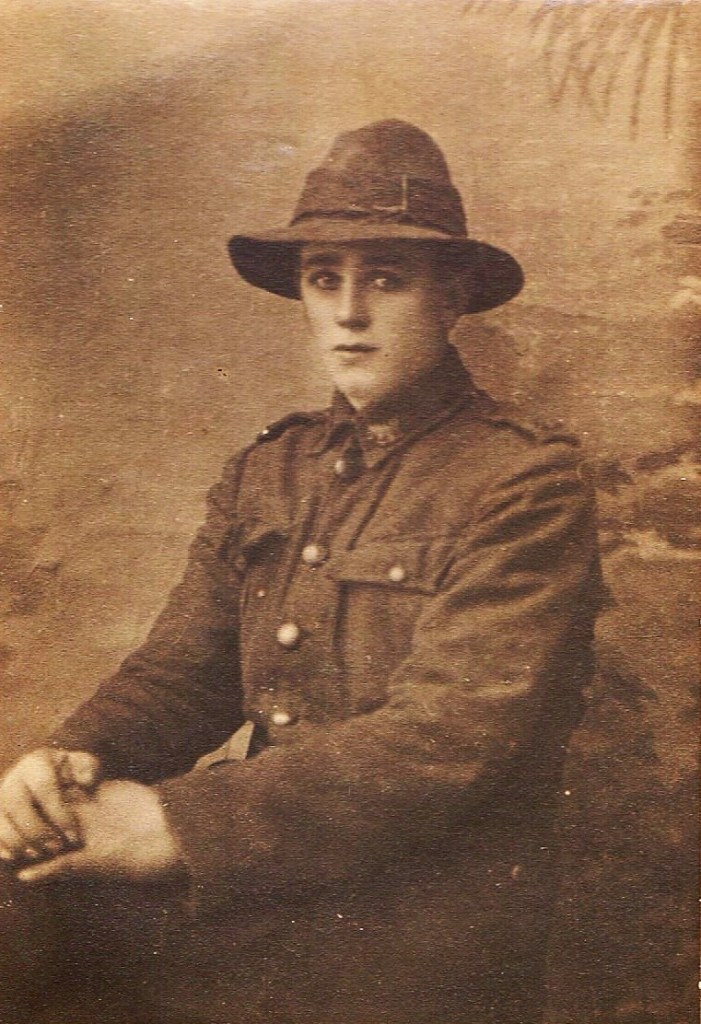
Harold, the youngest son, was born on the 16 July 1894 at Candelo, NSW and he was around two years old when the family moved to New Zealand. He attended school at Pukeoware and was working locally as a farm labourer when he enlisted in June 1915. Although the youngest he was the second son to enlist, signing up just after Ernest returned to NZ having been wounded in the Dardanelles.
29 June 1915 – 7 March 1918
NZ Mounted Rifles – Wellington and Auckland
Service Number 11/1541
Harold marched into camp at Trentham on 29 June 1915 and shipped out on 13 August from Wellington on HMNZT 28 SS Tofua as part of the 6th reinforcements of the NZ Expeditionary Forces. He landed in Mudros, Greece on 4 October and was posted to the Wellington Mounted Rifles. On 7 October the reinforcements were reassigned to the district where they were recruited, and he was transferred to the Auckland Mounted Rifles where he was reunited with many local lads from the Waiuku district. He was almost immediately besieged with health issues and on 29 October was admitted to the Convalescent Camp with dysentery. On 12 November he rejoined his unit at Zeitoun in Egypt.
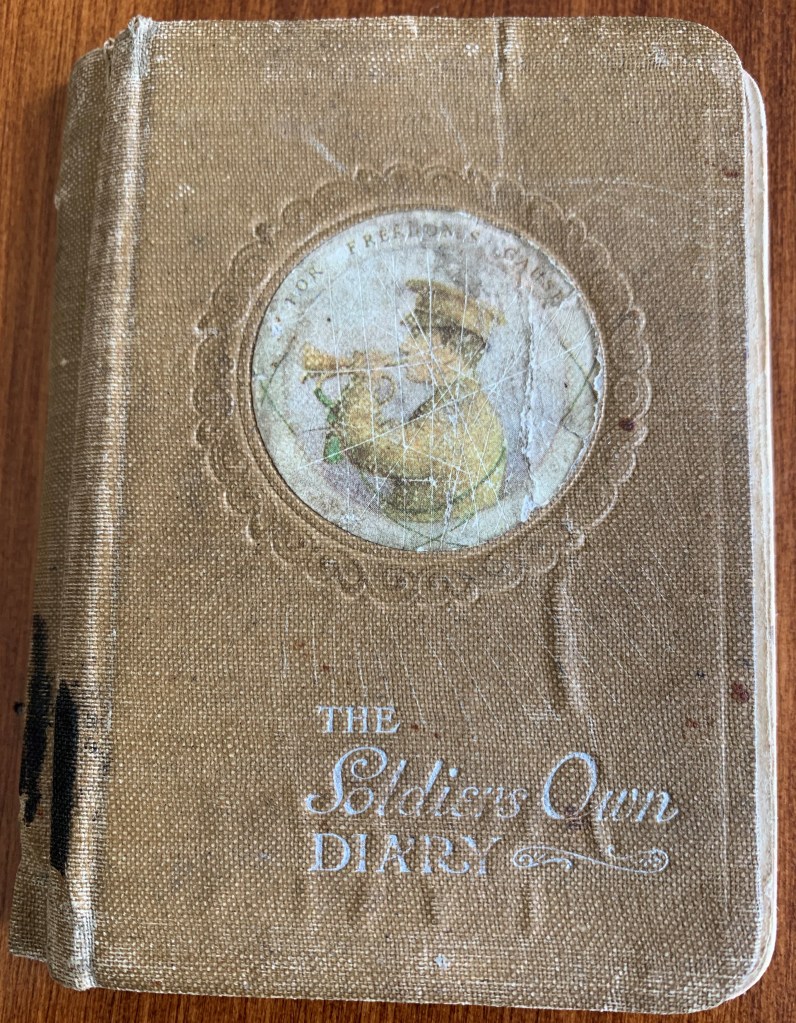
On 5 July 1916 Harold was posted to A company Reinforcements at Hill 70 where he saw active service. On 26 July he was transferred to the Sling Camp in England where he remained until 8 December when he was returned to Egypt. From 12 January 1917 he was based at Moascar Camp. He was again besieged with health problems, medical, dental and mental. He spent time at the hospital at Ismailia, the 26th Stationary Hospital at Abbassia, the Aotea Convalescent home at Abbassia, a hospital at El Arish, the 2nd Australian Station at Kantara, the 27th General Hospital in Cairo. From April to June 1917 he spent time in the field at the front line and then in a training camp by the sea learning to use the Hodgkiss gun. It was here he lost his false teeth in the sea which caused many later dental issues. His time in 1917 was documented in his Soldier’s Own Diary which was issued to each solder at the beginning of the year for them to keep a brief record of their daily activities. This diary is now safely stored in the collection of the Army Museum at Waiouru, and available to view. You would need to make an appointment first.

On 22 December 1917, after presenting to many medical boards, Harold was declared unfit for service and on 28 December was returned to New Zealand, arriving in Auckland 6 February 1918. He was discharged Medically unfit for Service 7 March 1918.
More about Harold in the war
Auckland War Memorial Online Cenotaph record
Wellington Mounted Rifles timeline
Auckland Mounted Rifles timeline
New Zealand hospitals in Egypt
Harold also served in WWII in the Waiuku Battalion, NZ Home Guard as a store clerk, 13 April 1943 to 18 July 1944
After the war
Ernie and Phoebe lived in Hamilton where Ernie worked firstly as a commercial traveller and then as accountant at the Waikato Bacon Company. Ernie died on 22 September 1963 and is buried at the Hamilton East Cemetery.
Ronnie married Susanna Winifred (Freda) Ernest in 1920 and was allocated Jersey Park in Waipipi through the Soldier Resettlement Scheme. Ronnie’s father, John McDonald, had sold the farm to the government for the Resettlement Scheme. Ronnies son, Ron, bought the farm from his father in 1953. Ronnie and Freda lived in Waiuku until Ronnie’s death in 1968. Ronnie was cremated at Purewa Crematorium, Meadowbank. Auckland.
Through the Soldier Resettlement Scheme Harold was allocated a farm on Creamery Road Waipipi, opposite Jersey Park. In March 1919 he married Mary Winifred Aylward, a daughter of one of the original Waipipi “Cape Pigeons”. Harold and Mary had six children – Elva Doreen (1919-2008), Rona Winifred (1921-2003), Alma Joyce (1922-1923), Ena Joy (1924-2000), Lindsay Kingsford (1928-), Kathleen Mary Ellen (1930- 2024).
During the Second World War Harold served in the Home Guard, Waiuku Battalion, 1943/44 as a storeman/clerk, and from the spirit of comradeship among the Waipipi contingent grew the Waipipi Bowling Club, which opened in December 1946 with Harold as its first president.
Harold and Mary farmed at Waipipi until 1953, when they retired to Waiuku. In 1986 Harold and Mary moved to Manurewa. Mary died in May 1987, aged 94, following a fall at home. In 1988 Harold moved to the Franklin Memorial Hospital on Kitchener Rd, Waiuku where he remained until his death on 16 August 1992, aged 98.
He is buried with Mary and their daughter Alma in the Waipipi cemetery alongside Mary’s parents Thomas and Matilda Aylward. Harold and Mary were survived by five children, eleven grandchildren and thirteen great grandchildren.
 Our Folk Stories