My great grandfather James Donelan was born in County Longford, Ireland in early 1823. Although no birth record has surfaced to date, James’s military service record from March 1864 lists his age as 41 years and 1 month, so he was likely born in February 1823. The record also states that his place of birth was the parish of ‘Kilcamick’, near the town of Kenagh (generally now written Keenagh, or Caonach). There is very little information about James’s family. His marriage certificate from 1861 names his father as Edward Donelan, a carpenter, deceased. In his military record, James’s occupation prior to his enlistment was ‘labourer’. This likely meant that he was employed by a tenant farmer, who would have rented their farm from the local baronet.
In the wake of the Anglo-Afghan War, the 44th East Essex Regiment of Foot needed to rebuild from scratch, having been wiped out in the British withdrawal from Kabul. To achieve this, it set up recruitment drives across Great Britain and Ireland, including from the Victoria Barracks in Athlone. It was here that James, aged 20, was recruited into the 44th Regiment of Foot on 13th February 1843. James, in his military service record, was described thus: 5 feet 7¾ inches, with a fresh complexion, hazel eyes and dark brown hair.
The regiment moved around considerably in the next few years. Among the places they were based in 1843 alone were Chatham, Canterbury, Chichester and Gosport. James was quickly promoted, first to Corporal in April 1844, then 4 months later to Sergeant. The regiment had by now moved on to Winchester, then Devonport, from whence it embarked for Dublin, arriving in May 1845. James was made Colour Sergeant in July 1847, a rank that probably recognised the quality of his service as a non-commissioned officer. In Ireland, the regiment continued on the move, eventually arriving in Cork, to embark on 11 April 1848 for Malta, James’s first overseas posting.
In early 1851, the regiment moved to another British territory in the Mediterranean, Gibraltar. They stayed there until March 1854. By then, momentous political upheaval was facing Europe. Russia was threatening the Ottoman Empire (based in Turkey). To prevent its overthrow, which would have caused great instability to British and other European powers’ interests, the British and French governments opted to join forces with the Ottomans against this threat from Russia. Although war was not officially declared until the end of March, preparations were underway well before that. The 44th Foot embarked at Gibraltar on 10th March, initially for Malta once more, though only briefly, before joining a large British and French force at Gallipoli, where they constructed entrenchments for the defence of the Ottoman capital, Constantinople. The regiment, along with the 4th and 28th regiments, constituted one of two brigades in the army’s Third Division, under the command of Colonel William Eyre. In late June, the division moved north to Varna on the Bulgarian Black Sea coast, where they joined the other two divisions of the army to support the Ottoman forces expecting to break the Russian siege of Silistra. However, the siege was lifted on 24 June and the Russian withdrawal signalled a reversal in the momentum of the war.
The allied forces decided to attack the Russians on the Crimean peninsula and elsewhere along the war’s front. On a fleet of ships, the British army crossed the Black Sea and landed unopposed, on 14th September, near Yevpatoria, some 60km or so north of the main Russian naval base at Sevastopol. They marched south along the coast towards where the Russian forces had established a strong position south of the River Alma. It was here that the first battle of the war was fought on 20th September. The Franco-British army prevailed and the Russians were forced to withdraw towards Sevastopol. The battle, in all, lasted little more than three hours. James, as a participant, was awarded the Alma clasp on his Crimean War medal.
James’s regiment left Alma on 24th September and arrived on the 26th at Balaclava, a small harbour south-east of Sevastopol that became the base for the British army. Thereafter, the 44th took its place in the line laying siege to Sevastopol. The Russians attempted to lift the siege by attacking the second division of the British army at Inkerman on 5th November. The third division, of which James was a part, was held back to maintain the entrenchments. The superior British arms were significant in driving the Russian troops back into the city, at huge cost of lives to both sides. Although the 44th had not been directly involved, its role was acknowledged, and James received an Inkerman clasp.
Sustaining the siege through winter was terrible. Illness, especially cholera, and sheer exhaustion were rife, and the regiment lost close to a third of its men due to these causes, rather than in battle. As the weather started to improve in March, bombardments of Sevastopol were recommenced. The defending forces were highly efficient at remedying damage overnight and by June no material advantage had accrued. Following a bombardment on the previous day, an attack on the city was mounted early on the morning of 18th June 1855, by the French against the fort at Malakoff and the British against the Redan, two strongholds of the Russian defence.

The 44th played a significant role in this day’s events. The main points of attack were on the eastern flank of the city’s defences but, in order to spread the defenders, “demonstrations” (military feints) were made in the west, both by army and navy. The 2nd Brigade of the 3rd Division, under General Eyre’s command, moved down one of the ravines emanating from the city, towards Dockyard Creek. By about 7am, Eyre’s troops had already made their way into the city, taking several houses on the periphery. They came under heavy fire from Russian batteries and ships at anchor in the inner harbour. While these advanced positions were too hard to hold, one part of the brigade of which James was a part occupied a small cemetery and were able to hold this until nightfall, despite being under fire for 18 hours. This was the only advanced position that was held by the besiegers that day. In his dispatches, General Eyre specifically recommended Colour Sergeant James Donelan, for his conspicuous gallantry. Ultimately, in September, the siege came to a victorious conclusion. A peace treaty was signed on 29th March 1856 and the British army was broken up to return to the United Kingdom.
In addition to the Crimean medal, with clasps for Alma, Inkerman and Sevastopol, the allied forces received the Turkish Crimean War Medal. Further, James was one of just 100 British soldiers selected to be a recipient of the French Military War Medal, issued by Emperor Napoleon III. The awards were noted as recognising military daring, endurance and kind-heartedness. Regarding James, the record of these medals states that “he served throughout the campaign and the siege of Sevastopol, until the spring of 1856 and, though never in good health, he persisted in remaining with his regiment”. The medal is the rightmost one in the display below.
The 44th Regiment of Foot embarked for home on 25th June 1856 and arrived at Spithead, Devon on 18th July. After making its way, with stays at several towns, to the Shorncliffe Army Camp in Folkestone, Kent, the regiment remained at home for just a few months before being sent as reinforcements to Chennai (Madras), India. This was in response to the Indian Rebellion. The unrest was centred in the north in Delhi and Lucknow whereas the coastal ‘presidencies’ (geographic divisions of the East India Company) of Mumbai (Bombay) and Chennai were largely unaffected. The 44th therefore was not directly involved in the fighting.
The regiment left its garrison at Fort St George in Chennai in January 1860 and was shipped first to Kowloon, the mainland part of Hong Kong, then on to Tianjin in the north of China. However, it is not clear whether James was part of this movement as his war service record states that he finished his posting in the East Indies on 29th August 1860, while the regiment was still on active service in China.
By early 1861, James was back in the United Kingdom. On 13th March, he was promoted to Sergeant Major and was assigned to the 10th Depot Battalion (Indian) in Colchester. The 1861 census, conducted on Sunday 7th April, lists James as resident at the Colchester Infantry Barracks, one of around 5,000 inhabitants. His promotion also resulted in a valuable increase in salary, from around £40 per annum as a Sergeant to £65. This was the mid-point of James’s life, both literally and figuratively. On 13th June that year, James Donelan, 38, married Emma Mary Ann Denbow, 20, at the Catholic Sardinian Chapel, Covent Garden, London.
Emma was the daughter of Richard Denbow and Mary Ann Easterbrook, a couple from Devonport, Devon. The 44th Regiment of Foot (East Essex) was recruiting in England as well as Ireland. In August 1843, the regiment was based in Gosport, just across Portsmouth harbour entrance from Portsea where Richard was employed as a tailor. Richard signed up with the 44th in Deal, Kent, in March 1843, barely a month after James. Richard travelled with the regiment to Malta, Gibraltar, Turkey and the Crimea, though as a tailor he may have been attached to the base depot rather than directly involved in battle. It seems Mary Ann died somewhere between 1844 and 1857, for in the second quarter of 1858, Richard remarried and had two more daughters. In the 1861 census, Richard and his new family plus Emma, were living on Military Road, part of the Colchester barracks, a short distance from James’s residence. Richard was a Sergeant and Master Tailor, Emma a bonnet maker. Two months later, James and Emma married, and Richard was a witness.
James continued as Sergeant Major in the 44th Regiment for the next few years. Their first child, Edward, was born at the Colchester Barracks in April 1863. James received the medal for long service and good conduct on 9th December 1863, with a one-off gratuity of £5. On 24th March 1864, he was discharged from service with the 44th Regiment of Foot at Camp Colchester. He had served just over 21 years, the length of service required to earn an army pension, almost 11 of those years overseas. On 12th April, he was admitted to the Royal Hospital Chelsea Pensioners.
James became a sergeant-instructor with the 37th Middlesex Rifles, which was a volunteer unit based in Holborn. Emma and James’s first daughter, also named Emma, was born in their Euston Road premises in early 1865. On 17th May 1866, James was appointed Sergeant Major for the Royal Longford Rifles, a Militia or reserve force. He was back in Ireland for the first time since 1848. Emma was already expecting their third child, Mary, who was born on 21st December 1866. Two further children, Agnes in 1869 and Thomas in 1871, were born in Longford. Devastatingly, though, Edward (Teddy) had died in an accident at their Longford home in 1868.
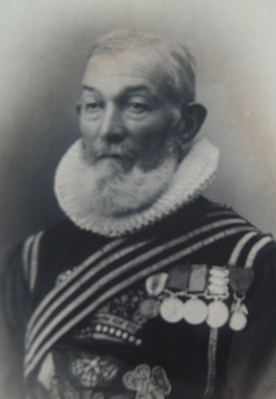
In 1872, James transferred to the 1st (Royal East) Middlesex Militia as Orderly Room Clerk at the Militia Barracks on Well Walk, Hampstead, commencing 1st January 1873. Also in 1872, James was appointed to the Royal Body Guard, the Yeomen of the Guard popularly known as Beefeaters. The number of Yeomen was at that time restricted to 64. Their duties officially included guarding the monarch, but in practice they were ceremonial and would be called on several times a year to participate in formal occasions.
The next few years witnessed the birth of four more children: Elizabeth in 1874, Catherine in 1875, James in 1877 and finally my grandfather, William Lawrence Donelan, in 1880. James and his family are recorded in the 1881 census as living in 27-28 Wells Buildings on Flask Walk in Hampstead. These were recently constructed tenement buildings for artisans. All but the oldest two girls in the family, Emma and Mary, were resident, those girls both working nearby in Hampstead. Emma was a dressmaker, and it may have been this that enabled the family to live in this artisan’s housing.

In 1887, since as a Yeoman of the Guard he was involved in the official celebrations, James was awarded the Queen Victoria Golden Jubilee Medal. This can be seen on the left in the photograph of James in his Yeoman’s uniform (likely taken around 1893). Ten years later, the clasp for the Queen’s diamond jubilee was added, seen at the top in the medal display, above the medal itself.
During the next 10 years, the family moved to a terraced cottage at 61 Flask Walk, Hampstead. There, after several months of illness, Emma died as a result of cancer on 9th February 1890. In the 1891 census, James, now 69, and several of his children were living still in Flask Walk. His eldest daughter, Emma, now 26, was housekeeper, Thomas, 20, a commercial clerk and Elizabeth, 17, a ‘pupil teacher’. Also in the house was James, 13, a scholar. Mary was by now Headmistress at the Catholic Church school of St Catherine the Martyr in West Drayton and her younger sister, Catherine, was a teacher there too. William, 10, was a student at the Royal Military Asylum, Chelsea, a school established in 1801 for the children of soldiers in the regular army.
Electoral registers show that James remained at Flask Walk throughout the 1890s. In 1898, likely because of declining health, he retired from the Yeomanry of the Guard after 26 years’ service. In the last 18 months of his life, he suffered from hemiplegia – paralysis of one side of his body – and he died on 9th January 1900, aged 78. His death was recorded by his oldest surviving son Thomas. The Hampstead and Highgate Express ran an obituary for James on 13th January, under the heading Death of a Crimean Veteran. It concludes, “Altogether he spent 57 years in Her Majesty’s Service, a record not often eclipsed”.
Sources and stuff that may be interesting:
Carter, Thomas; Historical Record of the Forty-fourth: Or the East Essex Regiment of Foot …, 1864
Wounded officer carried to the rear
Carter, Thomas and Long W.H.; War Medals of The British Army 1650-1891, And How They Were Won
 Our Folk Stories
What a guy ❤️
LikeLiked by 1 person
Great stuff! Hugely interesting.
LikeLiked by 1 person