James Donelan and Emma Mary Ann Denbow were married at the Catholic Sardinian Chapel near Lincolns Inn Fields, London, on 13th June 1861. James, born in 1822 in County Longford, Ireland, was 38 and had served in the 44th Regiment of Foot (East Essex) for the previous 18 years, including fighting in the Crimean War and being posted to India during the Indian Rebellion in the late 1850s. He had recently been promoted to Sergeant Major and was stationed with his regiment’s depot in Colchester barracks.
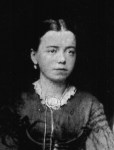
Emma was 20, the daughter of Richard Denbow and Mary Ann Easterbrook, both tailors from Devon. Emma was born in Portsea, Hampshire, on 20th April 1841. Richard had also enlisted with the 44th Regiment of Foot in 1843 and had been posted overseas until returning from the Crimea in 1856. Mary Ann must have died in the intervening years for Richard remarried in 1858. In 1861, Emma was living with her father and stepmother, as well as two small half-sisters, on Military Road, also at the Colchester barracks, where she was a bonnet-maker. Over the next 20 years, James and Emma engendered a family of nine children.
Emma gave birth to their first child in the second quarter of 1863. This was a boy, Edward, named for his paternal grandfather – common practice up to the 19th century, especially in Scotland and Ireland. The family was living at the Colchester barracks in Essex, where James was still stationed. James retired from the 44th Regiment of Foot and, having served 21 years, became a Chelsea pensioner. However, he continued in military roles for the remainder of his life and at this time was sergeant-instructor with the 37th Middlesex Rifles, which was a volunteer unit. This entailed the family moving to 142 Euston Road, St Pancras in London. Their first daughter, Emma, was born there on 7th December 1864.
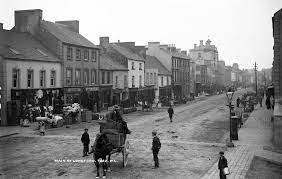
In 1866, James was appointed Sergeant Major with the Royal Longford Rifles, a Militia (or reserve) force in his home county back in Ireland, and the family moved there for the next several years. Emma was already expecting their third child. The family lived initially on New Street, where Mary was born on 21st December 1866. One wonders what took James back to Ireland. Was it simply a work opportunity, nostalgia for Ireland, or did he have surviving family still living near Longford?
On 30th May 1868, tragedy happened at home. Edward, known to the family as Teddy, was playing alone in the yard one evening when he climbed up and fell into a water barrel, head first. By the time he was discovered by the family’s maidservant, Teddy had drowned. James’s attempt to revive him were to no avail. The Longford Journal, reporting on the subsequent inquest, which took place only two days later in James and Emma’s very house, recorded the event under the headline “Melancholy occurrence”; true, but surely an understatement. The inquest jury returned a finding of accidental death. James asked that the newspaper record his acknowledgement of the help of the doctor from the 1st Royal Dragoons, who happened to be staying at the nearby hotel.
It is impossible to gauge the impact the tragic event had on James and Emma, not to mention on Teddy’s younger sister Emma. While childhood fatalities, from disease or accident, were more prevalent in those times, there is no reason to suppose the impact would have been different than in the present day. James and Emma remained in Longford, soon moving to Earl Street between the centre and railway station, where they stayed until until 1872. Two further children were born there, Agnes on 29th March 1869 and Thomas on 14th February 1871.
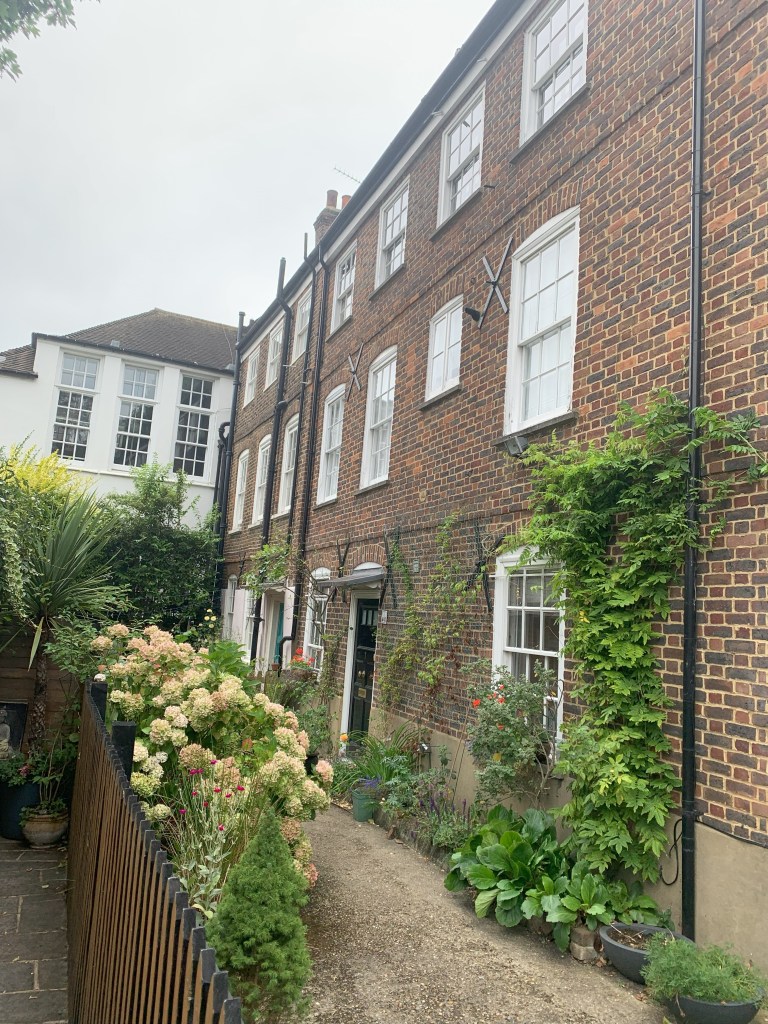
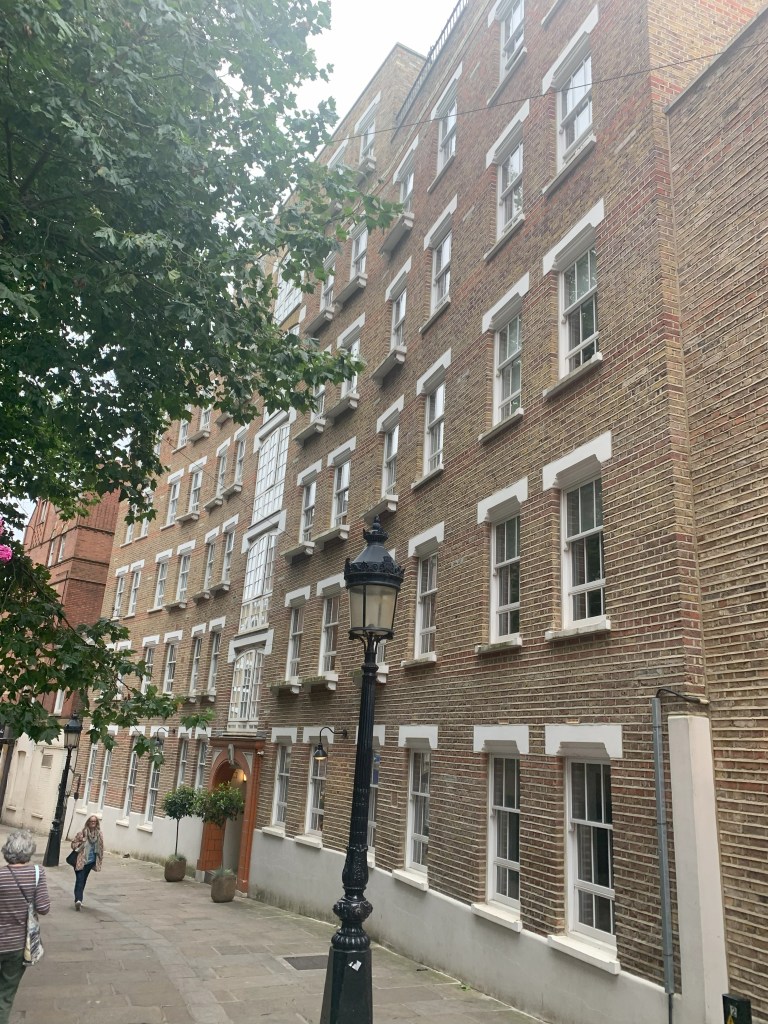
Another move occurred in 1872, when James was appointed as Orderly Room Clerk of 1st (Royal East) Middlesex Militia, based at the Militia Barracks on Well Walk, Hampstead, a role he commenced 1st January 1873. Also in 1872, James was awarded the prestigious appointment as a Yeoman of the Guard (or Beefeater). The Yeomanry (distinct from the Yeoman Warders of the Tower of London), was originally constituted as a personal bodyguard for the monarch by King Henry VII in 1485. Their role by the time of Queen Victoria was purely ceremonial. The family took up residence at 9 The Square, Hampstead. Here, Elizabeth was born on 22nd May 1873, followed by Catherine on 19th May 1875 and James on 25th November 1877. Around this time, the family moved to brand new artisans’ tenement dwellings at 27-28 Wells Buildings on Flask Walk, Hampstead, which had been constructed on the site of cleared slum dwellings at Cotter’s Court, by the Wells Charity. It was here, on 19th July 1880 that the last child in the family, William, my grandfather, was born.
In 1881, the year of the next national census, James and Emma were living at 27-28 Wells Buildings along with the 6 youngest children. Emma was a dressmaker. It may have been that profession that entitled them to this artisan’s housing, though neighbours had a variety of jobs such as bricklayer, needlewoman, gardener, coachman, and one other was also an Irish-born army pensioner. Of the children, all but William, just 8 months old, were listed as scholars. The two oldest girls were living not far away in Hampstead: Emma, 16, was working as a servant for the Buckle family at 1 Flask Walk. George and Elizabeth Buckle ran a fruiterer and greengrocers there and had two young children. Mary, 14, was a nurse girl at the Hare and Hounds on North End Way. She would also have been looking after the two young children of the licensee, William Brett. (The public house was destroyed by bombing in World War 2.)
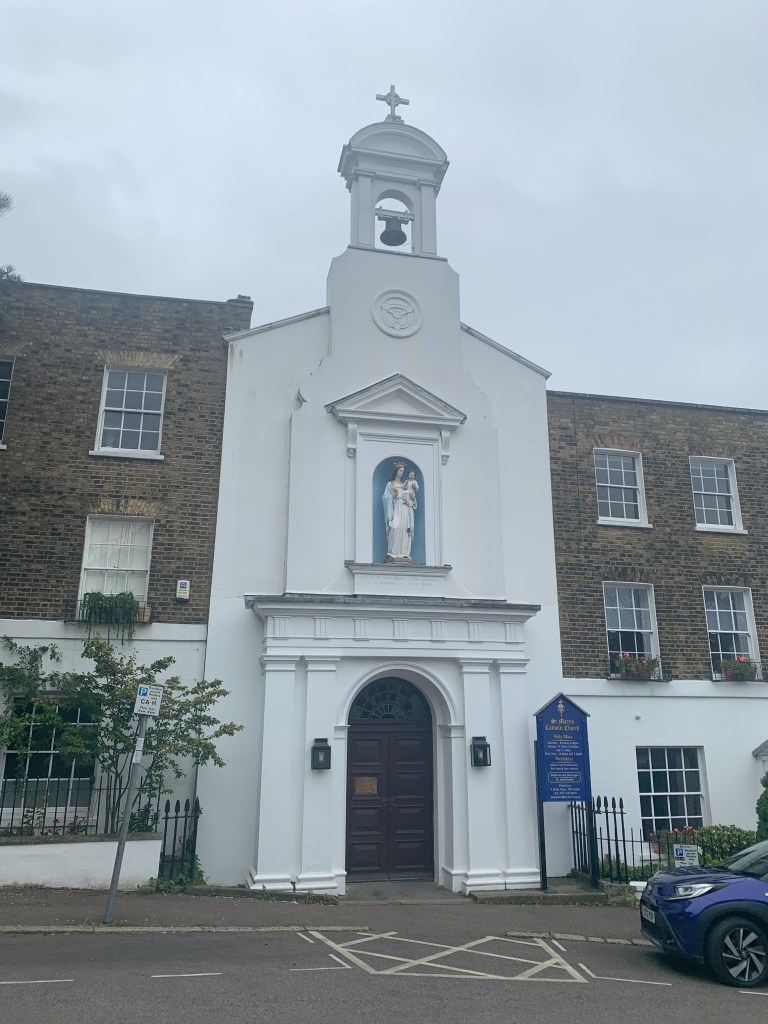
The children had all been baptised as Catholics, each with just one forename. In Hampstead, they were part of the congregation of St Mary’s Catholic Church on Holly Walk, near Hampstead town centre. Hampstead had been home to several hundred Catholic refugees from the French revolution, among them Abbé Jean-Jacques Morel who was responsible for establishing the church in 1816. The Donelan children were probably there confirmed (a Christian ceremony, following baptism and first communion among the Catholic sacraments) and some, at least, took ‘confirmation names’ – typically the name of a saint whose life or virtues were seen as inspirational. The confirmation names in the family that we know are Thomas Valentine, Elizabeth Agnes, James Francis and William Lawrence. Thomas had been born on St Valentine’s Day.
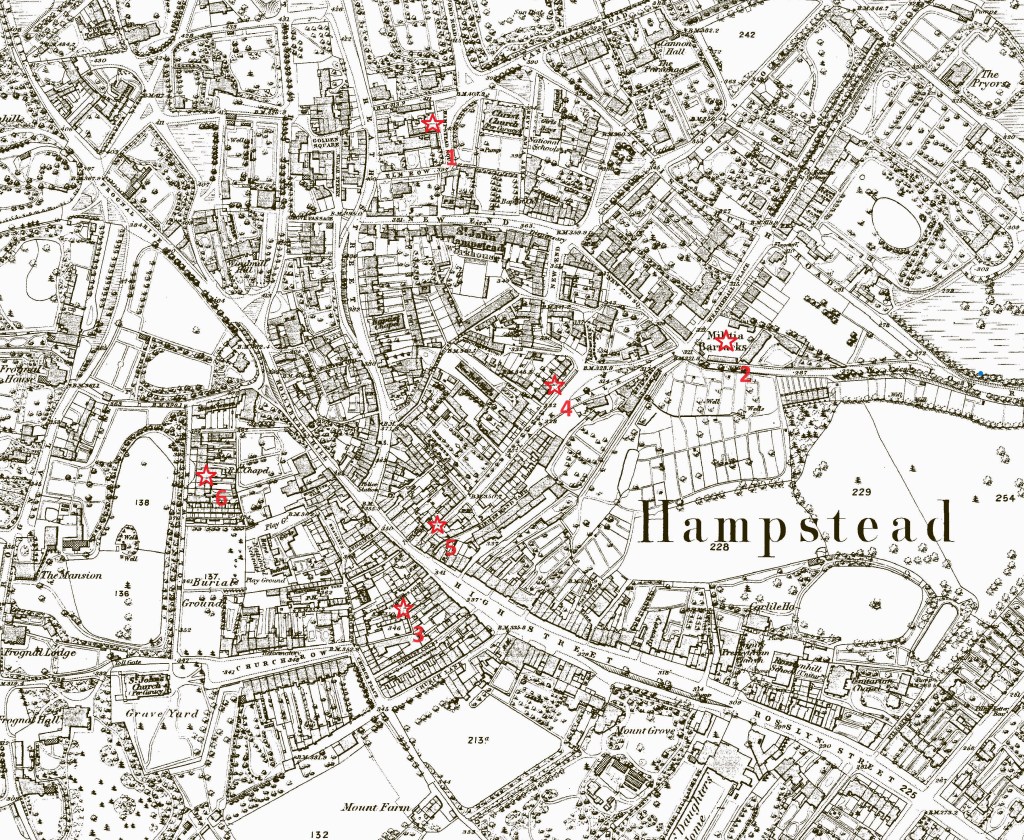
1. The Square; 2. Militia Barracks; 3. Wells Buildings; 4. 61 Flask Walk; 5. 1 Flask Walk; 6. St Mary’s Church.
A new school for Catholic pupils was built behind the church in the 1870s and it is probably there that the younger children started their education. From the Hampstead and Highgate Express, 24th December 1881, we read that Agnes was awarded the 25s (£1 5s) prize for school attendance and proficiency at the St Mary’s Roman Catholic Schools. The prize-winning children received a certificate, while the quite handsome prize was entrusted to their parents.
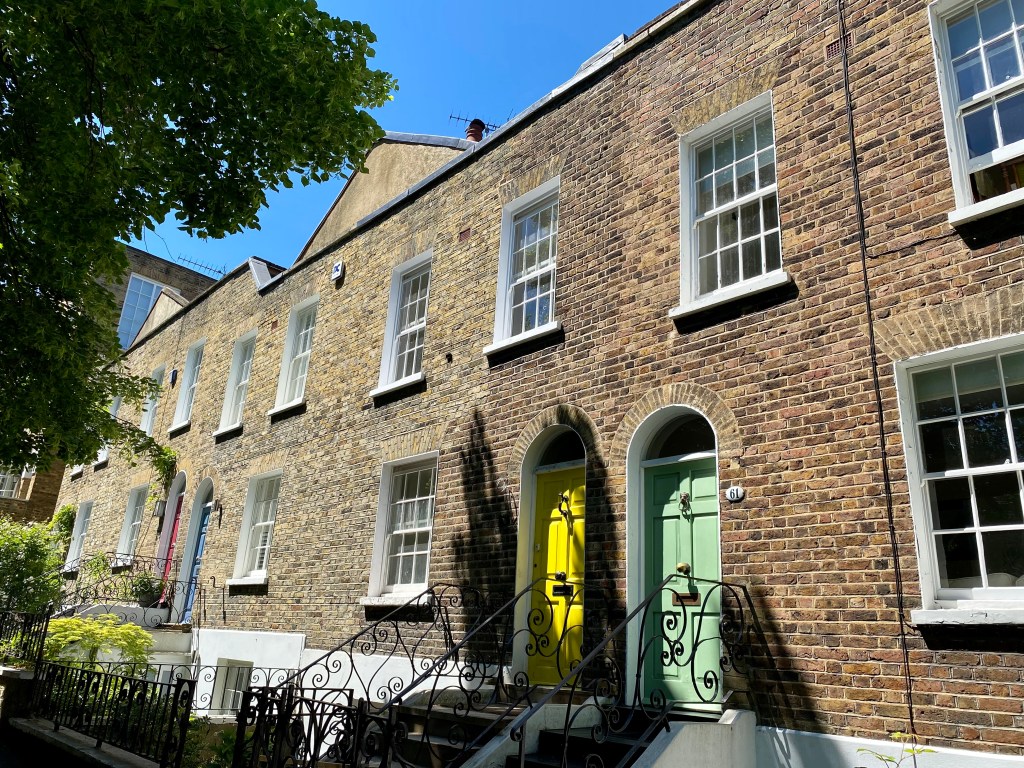
In 1884 or 1885, the family moved to 61 Flask Walk, which would be James’s home until he died. Soon, tragedy struck the family once more. Their mother Emma, aged only 47, was diagnosed with cancer in the latter part of 1889 and died on 9th February 1890. James was now 67, William only 9.
Part 2 – Into Work
Part 3 – Weddings and Families
Part 4 – The Great War
Part 5 – Later Years
Further info:
- Longford, Irish Historical Towns Atlas, Royal Academy of Ireland
- The Yeomen of the Guard
- British History Online: Hampstead Town
- St Mary’s Catholic Church, Hampstead
 Our Folk Stories
4 thoughts on “The Family of James Donelan and Emma Denbow. Part 1 – Childhood”