James’s and Emma’s nine children were: Edward (born 1863 and died 1868), Emma (born 1864), Mary (1866), Agnes (1869), Thomas (1871), Elizabeth (1873), Catherine (1875), James (1877) and William (1880). With over 15 years between oldest and youngest surviving children, by 1891, a national census year, the oldest six were largely in employment, whereas the youngest two were still at school. Emma was living at 61 Flask Walk with her father and was acting as housekeeper. Also at Flask Walk were Thomas, now a commercial clerk aged 20, Elizabeth who was a pupil teacher and James, 13, who was at school.
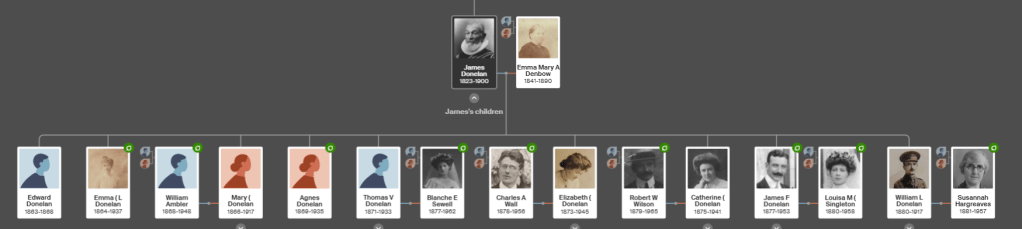
Elizabeth was following on the path of her older sister Mary, who had attended the Wandsworth Training College for Roman Catholic women teachers. The college was on the grounds of the Convent of the Sacred Heart on Putney Bridge Road. In the supplement to The Tablet, a weekly Roman Catholic ecclesiastical newspaper, in March 1889 Mary had been listed as completing her first year, and in 1890 her second year, of a two-year programme, finishing with a Diploma in the Second Division. A contemporary of hers at the college was Mary Anne Hargreaves, whom we soon encounter again. In 1891, Elizabeth, now known as Lily, was successful in gaining admission to the College and she graduated (Third Division) the following year.
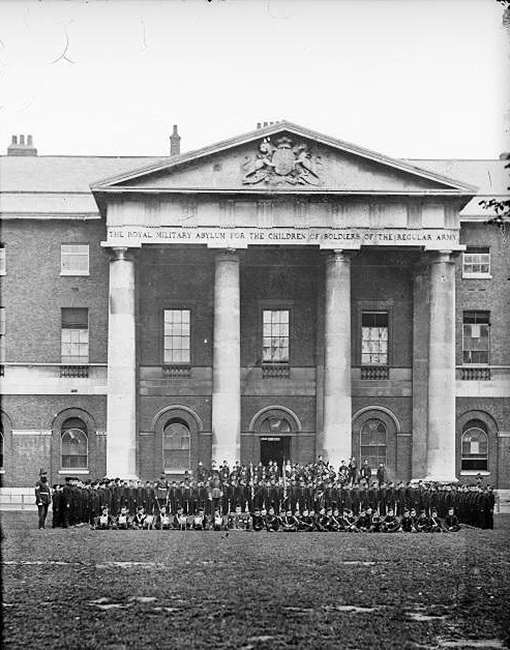
The remaining four children who were not resident at Flask Walk in 1891 were variously engaged. Mary, having graduated from the teachers college, was head of the Catholic Elementary School at St Catherine’s RC church in West Drayton, Middlesex. She was working there with her younger sister, Catherine, just 15, who was described as a teacher. They were living at Hope Cottage, on the Green (now a grade II listed building). Agnes was serving as a housemaid for the Eisenlohr family, living at Ardlethen, one of the grand houses on the west side of Hampstead Heath. Frederick Eisenlohr was described as an East India merchant. Finally, William (my grandfather) was enrolled as a student at what was then known as the Royal Military Asylum, in Chelsea. This had been established in the early 19th century to educate orphans of soldiers in the Napoleonic war, and later became a school for children of soldiers in the regular army – James, at this stage was a Yeoman of the Guard. In 1892, the Asylum was renamed the Duke of York’s Royal Military School. The building now houses the Saatchi Gallery.
In 1893, the Westminster Roman Catholic Diocese undertook its own census. James and all the children were listed, associated with the family’s residence at 61 Flask Walk, in the parish of St Mary’s, Hampstead. Emma does not have a listed occupation, but Mary is a teacher and Elizabeth still a pupil teacher. Agnes and Catherine are servants, Thomas is in civil service, James attending the City of London Day School, for which he had won a scholarship, and William still at the Duke of York’s School. Thomas is also noted as belonging to the Guild of the Sacred Heart. James’s school was located on the Embankment and is still there in modern premises. By this time transport from Hampstead into Blackfriars would have been moderately straightforward using horse-drawn omnibuses. The Hampstead underground line did not open until 1907.
In the second quarter of 1893, Mary married William Ambler. William had been born in London in 1869 and his father, George, was a gardener. In 1871, William was living with his family in the Gardener’s Cottage at Oatlands Drive, Victoria Road, Walton-on-Thames. By 1879, he was one of six brothers. In 1881, they were living at Devonshire Hill, Hampstead. On 2nd October 1894, Mary and William’s first child, William Noel, was born and his birth registered in the district of Hanover Square in London. They may already have been living on Great George Street, which was their residence in 1901.
James had declined into ill health by 1898, suffering from hemiplegia – partial paralysis – possibly as the result of a stroke. He died at Flask Walk on 9th January 1900, in the presence of Thomas and almost certainly others of his children. The youngest child, William, was by now 19 and the siblings were well placed to establish their own paths while remaining mutually supportive.
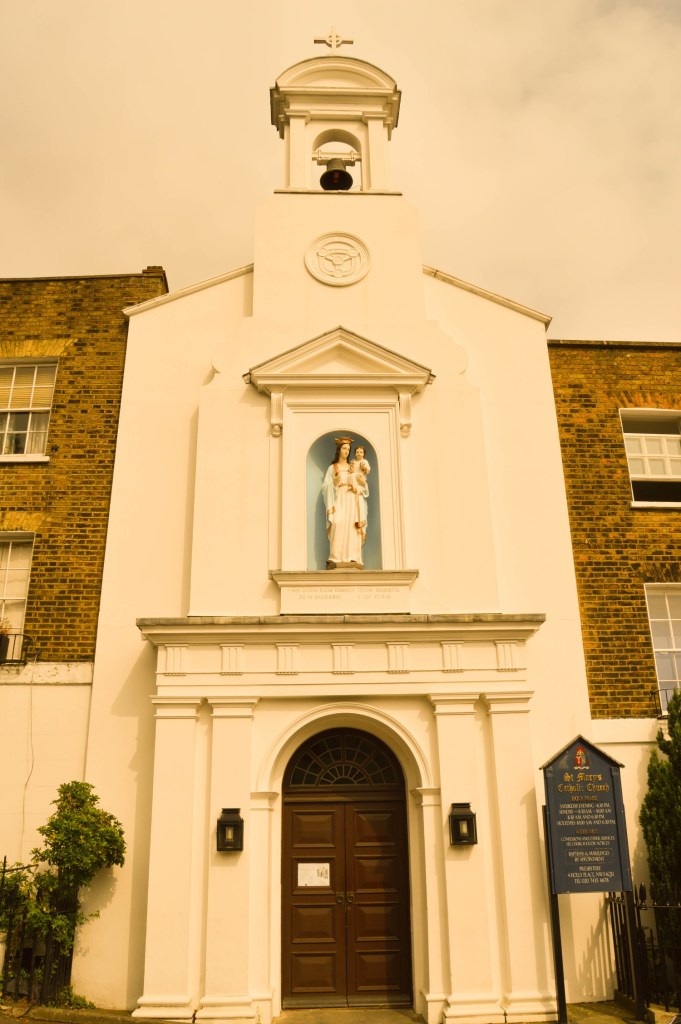
The Hampstead and Highgate Express of 5th May 1900 reported on a “most successful concert”, under the auspices of the Young Men’s Guild of the Sacred Heart (of which Thomas was a member) and directed by Will (sic) Donelan and a colleague. It took place at St Mary’s church on Holly Place. Among the performances were recitations by Lily (Elizabeth) Donelan, one of which was “deservedly encored”. There were also songs and duets by a Louisa Singleton. It may be her that in due course became a member of the Donelan family, a story for a little later on.
Emma, who had devoted herself to caring for her father, now had to move on. In the 1901 census, she was resident at Winkworth Hall, on the corner of Salusbury and Chevening Roads in Willesden, North London, where she was the cook. This was a hall of residence for students at the Maria Grey Teacher Training College. (The hall was named after Emma Winkworth, the first woman to climb the Jungfrau mountain and a leading women’s suffrage supporter.)
Thomas resided at a house at 11 Clifton Street (now Avenue), Hammersmith. Here, in 1901, he was living with his younger siblings Catherine, now calling herself Kate, James and William. Thomas was a commercial traveller, James and William both commercial clerks, while Kate was managing a sweet shop. As boarders in the Clifton Street house were Mary Anne Hargreaves (who had attended Wandsworth Training College with Mary Donelan) and her younger sister, Susannah. Mary Anne was now a teacher, while Susannah, aged 19, had no occupation listed in the census.
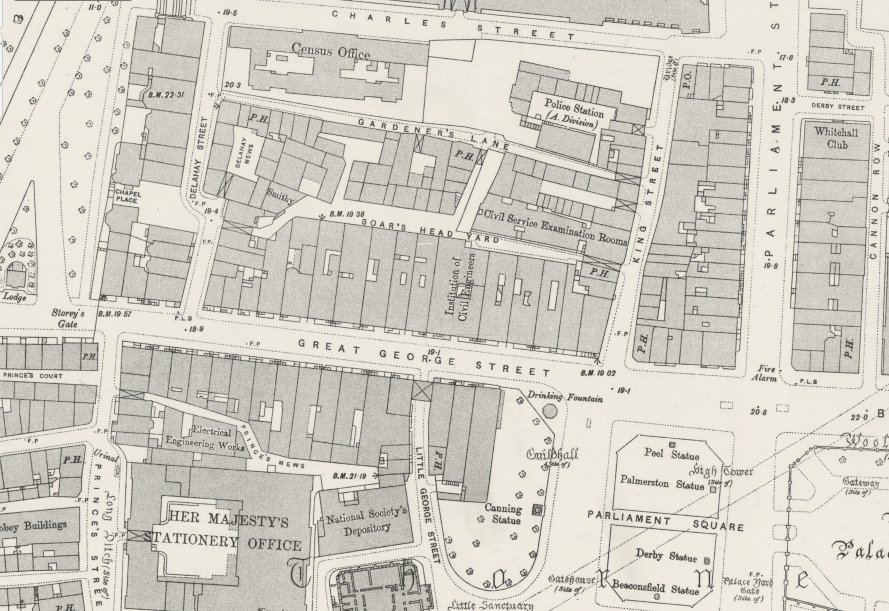
Mary and William Ambler, in 1901, were living at 34 Great George Street, in the heart of Westminster. William was employed as a Land Agent’s Clerk. The street appears to have been something of a centre for this profession – the Surveyor’s Institution was at number 12 and one of the leading agencies, Rawlence and Squarey, who undertook at a significant price the training of land agents, were at number 22. The houses were subsequently replaced by government offices.
Lily, in 1901, was living at Caversham Road, Kingston-upon-Thames, Surrey, and was a teacher at St Agatha’s RC School. What had become of Agnes at this time is unclear – she does not appear in the 1901 census. Much later in life she is recorded as having been a governess, a role which involved the care and education of a child or children in a family. Often, that might involve living overseas and it seems plausible that is what Agnes was doing.
The family were all by now, it seems, establishing themselves. Over the next few years, before the commencement of the Great War, there were several weddings and families, and the siblings move further across south-east England away from London.
Part 1 – Childhood
Part 3 – Weddings and Families
Part 4 – The Great War
Part 5 – Later Years
Further info:
- Wandsworth Training College: https://www.conventcoop.org.uk/our-history/
- Royal Military Asylum, Chelsea: https://historicengland.org.uk/services-skills/education/educational-images/royal-military-asylum-kings-road-chelsea-london-10241
- City of London School https://en.wikipedia.org/wiki/City_of_London_School
- Mary Grey Training College: https://en.wikipedia.org/wiki/Maria_Grey_Training_College
- English, B. (1984). Patterns of Estate Management in East Yorkshire c 1840—c 1880. The Agricultural History Review, 32(1), 29–48. http://www.jstor.org/stable/40274302
 Our Folk Stories
4 thoughts on “The Family of James Donelan and Emma Denbow. Part 2 – Into Work”