James’s and Emma’s nine children were: Edward (born 1863 and died 1868), Emma (born 1864), Mary (1866), Agnes (1869), Thomas (1871), Elizabeth (1873), Catherine (1875), James (1877) and William (1880). Mary married William Ambler in 1893 and they had a son, William Noel. Thomas married Blanche Sewell in 1904 and they had two surviving sons, John and Denis. Lily (Elizabeth) married Charles Wall in 1907 and their daughter, Barbara, was born in 1912. Kate (Catherine) married Robert Wilson in 1913. James was married to Lola Singleton in 1906 and they had five children: Margery, Joan, Betty, Jimmy and Peggy by the start of the war. William had married Susannah Hargreaves in 1904 and they had four children: Pat (Sydney), James, Kathleen and Gerald.
The United Kingdom declared war on Germany on 4th August 1914, after the German army invaded Belgium. William, having attended military school as a child, had reactivated the family’s military connections, enlisting with the Territorial Forces on 19th May 1909, in the Home Counties Divisional Cyclist Corps. Then he transferred into H Company, 1/1 Kent Cyclist Battalion. He was steadily promoted from Private to Sergeant in 1914. At the outbreak of war, he was still a part-time soldier in this battalion, one of whose companies was based at Sandgate.
In February 1915, Kate gave birth to her and Robert’s daughter Eileen Joan Loveday. They were living on Dover Road, Wanstead in east London.
As the war intensified and prolonged, there was a growing expectation that civilian men would enlist, though conscription was not brought in until 1916, when any able male between 18 and 40 was liable to be called up. Thomas was already in his 40s when the war began, but James and William, as well as Charles and Robert, were all under 40, as also was Mary’s son Noel (William). From October 1915, a form of deferred enlistment was introduced, and James attested for service in December 1915, with service to commence in 1917, should the war continue. At his medical examination in mid-1916, he was recorded as 5’ 11” (180cm), 208 lbs (94kg) and chest 43” (109cm), so a large man.
Robert, who had served two years as a volunteer, also completed his short service attestation in November 1915, with enlistment deferred until October 1916. He was mobilized as a chemist with the Royal Engineers, with the rank of Pioneer. The development of chemical warfare, such as gas, during the war made this an important role and restrictions on both age and physical condition were relaxed. From the Special Brigade Depot at Chatham, he embarked for France in late October. During his period of service, Kate and daughter Barbara moved to Rose Cottage, Sandgate, with Susannah and her family. Noel also fought in France for the Royal Field Artillery, first as a Corporal and then gaining a temporary commission as a Second Lieutenant.
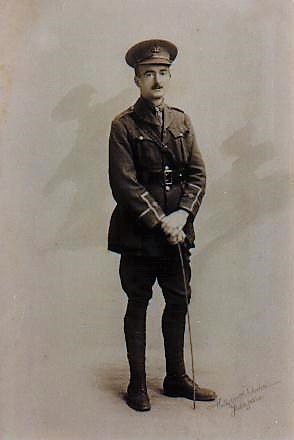
William had remained in the Territorials, in various cycle divisions, their responsibilities being message delivery and checking on coastal defences. In mid-1916, William also applied for a commission as an officer. In contrast to his older brother James, William weighed in at a slight 138 lbs (63kg). He was accepted for officer training in Cambridge, then in January 1917 he gained a temporary commission as Second Lieutenant with the 3rd Regiment of Foot (Royal East Kent), also known as The Buffs. He received orders to be shipped across the Channel and join the frontline of the war and he was there with his battalion on 10th February 1917. They were to take part in the Battle of Arras. Forces alternated between frontline duty in the trenches, which included, for William, leading trench raids against the German lines, and periods of recuperation and refreshment behind the front. For William’s unit, this was at the small mining village of Bully-Grenay (later named Bully-les-Mines) in northern France, where the soldiers camped in communal buildings, the officers more often in houses. The German forces, aware that the allies were actively preparing for an offensive, brought up extensive artillery and would regularly pound the areas behind the lines. On 4th April, William and his comrades were in Bully-Grenay and enjoying the concert party, The Buffellows. However, there was a heavy enemy bombardment and the soldiers returned to their billets. On Thursday 5th April 1917, a shell landed directly on William’s billet, and he was killed instantly. Susannah received a telegram on the 9th (the day the Battle of Arras commenced) from the Army Council informing her of her husband’s death and expressing deep sympathy. William was buried at Bully-Grenay Communal Cemetery, now tended by the Commonwealth War Graves Commission.
On the very day that William was killed, his brother James was mobilised, with the Army Pay Corps, though he would have been unaware of his brother’s fate for several days. This was just the beginning of a run of devastating misfortune for the family. On 26th May 1917, their sister Mary died from a stroke at her home in Folkestone, aged just 50. Then in August, James and Lola’s youngest daughter, Peggy, died from diphtheria.
In October, James, just short of his 40th birthday was transferred to the Royal West Kent Regiment (The Queen’s Own). Robert had a short period of leave back in the United Kingdom before returning to France. James also embarked for France in March 1918. On 30th June, he received bullet wounds to his left arm and leg while in action and was shipped home, first at Charing Cross Hospital, London, from 4th July to 1st August and then transferred to the military hospital in Tipperary, Ireland, until the end of the war in November. Back in Ealing, Lola gave birth to another daughter, Molly Noreen, but she survived just one month.
By the war’s end, only six of the Donelan children remained alive, with five of their spouses and 13 grandchildren of James and Emma. The following years must have brought considerable relief from the stress of war, as those grandchildren matured into adulthood. The family’s remaining years are the subject of Part 5.
Part 1 – Childhood
Part 2 – Into Work
Part 3 – Weddings and Families
Part 5 – Later Years
Further info:
- The Royal East Kent Regiment (The Buffs) https://www.nam.ac.uk/explore/buffs-royal-east-kent-regiment
- Bully-Grenay Communal Cemetery, British Extension https://www.cwgc.org/visit-us/find-cemeteries-memorials/cemetery-details/3100/bully-grenay-communal-cemetery-british-extension/
 Our Folk Stories
4 thoughts on “The Family of James Donelan and Emma Denbow. Part 4 – The Great War”