James’s and Emma’s nine children were: Edward (1863-1868), Emma (born 1864), Mary (1866-1917), Agnes (1869), Thomas (1871), Elizabeth (1873), Catherine (1875), James (1877) and William (1880-1917). Mary had been married to William Ambler and they had a son, Noel. Thomas was married to Blanche Sewell and they had two surviving sons, John and Denis. Lily (Elizabeth) married Charles Wall in 1907 and they had a surviving daughter, Barbara. Kate (Catherine) married Robert Wilson and their daughter was Eileen. James was married to Lola Singleton and they had four surviving children: Margery, Joan, Betty and Jimmy. William’s widow was Susannah Hargreaves and they had four children: Pat (Sydney), James, Kathleen and Gerald.

After the awfulness of the war years, Lola and James had one more child, William Douglas Scott, born on 17th December 1919, perhaps named for his late uncle who had died in the war in 1917. In 1921, Charles and Lily were living at the School House at the council school in Merstham, with their daughter Barbara, now 9 years old. She may have been unwell as the census records her as attending school only part-time. Living with them was Lily’s oldest sister Emily, listed as undertaking “home duties”. Emily was 57. It was almost 100 years since the birth, in Ireland, of their father James.
Thomas and Blanche were living at Paynesfield Avenue in East Sheen, west of London. Thomas was a bookkeeper for F G Wigley, a merchant and clothing manufacturer in the City of London. Their two sons, John, 15, and Denis, 13, were both at school. Robert had returned to teaching after the war and he and Kate were living at Westminster Drive, Westcliffe-on-Sea, Southend, with their daughter Joan, 6, now at school. Robert was teaching in Manor Park, Essex. James and Lola were, at this time living on Disraeli Road, Ealing, north of the river but not far from his brother Thomas. Their four older children, Margery, Joan, Betty and James, aged 13, 12, 10 and 9, were at school and the baby, William, now 18 months, was at home. Also living with them were Lola’s parents and a sister, so a full house. Once again, the 1921 census did not have a record of Agnes.
Mary’s widower, William, had remarried in October 1918, to Ellen Measures, and they had a daughter, Grace, in 1918. In 1921, his new family were still living in Folkestone and he was now an accountant for the Earl of Radnor’s estate. The late William’s widow, Susannah had moved back to London and was living at Knights Hill, Norwood in South London with the three younger children, James, 14, Kate, 12 and Gerald, 10. Sydney, now calling himself Patrick (later still he was just Pat), following in the family tradition of education, was a teacher trainee at the Roman Catholic Les Vauxbelets College at St Andrew’s, Guernsey. He was a very able linguist.
In July 1922, the Surrey Mirror and County Post reported that Lily and Charles’s daughter Barbara, following in her mother’s musical footsteps, had gained Honours in her Trinity College of Music piano examination. Further examination success with the Associated Board of the Royal Academy and Royal College of Music occurred in the following years. However, tragedy struck the family once more, when Barbara died in March 1925. A quiet, private funeral took place in Merstham, as recorded in The Surrey Mirror and County Post on 13th March. It was attended by members of the family – Lily and Charles, of course, uncle and aunts, Thomas and Blanche, Emily, Agnes and Susannah and Barbara’s cousin (William) Noel Ambler. This was the first record of Agnes that I could find since the 1893 Catholic census.
By the 1930s, the surviving children of James and Emma were at least in their 50s. In 1933, Thomas, aged 62, died, survived by his wife, Blanche, and sons, John and Denis. In January 1935, Agnes had a stroke. She had been living at 4 Temple Court, East Sheen, but it seems she moved to Reigate, to the School House that was home to her sister Lily and brother-in-law Charles. Her health deteriorated and she entered the Grange Nursing Home in nearby Redhill, where she died on 26th June, aged 66. In her will, Agnes left her estate to her nephew William Noel Ambler. Their oldest sibling, Emily (Emma), who had been living with Lily and Charles in 1921, was now living with or near Kate and Robert in Westcliff-on-Sea in Southend. On 8th August 1937, Emily, died at Southend Municipal Hospital in Rochford, leaving her estate to her brother-in-law Robert and family. She was 72 years old.
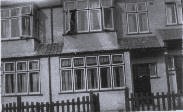
Regarding William’s family, in 1926 Susannah bought a brand-new, modest, terraced house in Beckway Road, Mitcham, Surrey, where she and their four children lived right up to the Second World War. By that time just three of the siblings – Lily, Kate and James – still lived. As the war began in September 1939, the government compiled a Register of those living in England and Wales, in order to create identity papers. From this, we learn that Lily and Charles were still resident at the School House, Merstham. Kate, by contrast, was registered in Doncaster, Durham, living with the Prior family. Thomas Prior was a steel mill inspector, living with his wife Gertrude and son John, a 27-year-old clerk in the War Department. Kate was accompanied by her daughter, Joan (Eileen), who was a nursing auxiliary. Kate’s husband Robert was registered as living with his sister, Frances, in Ipswich. The family’s relocation may well have been because of the war – Southend (and the Thames estuary more generally) were both a bombing target because of shipbuilding and were used as a dumping ground by German bombers returning from missions over London.
Conscription was reinstated at the beginning of the war and, in principle, included almost all of James and Emma’s grandchildren – for men the ages of conscription were 18-41, later 51, and for unmarried women 20-30. William and Susannah’s sons, James and Gerald, saw active service. James (always known as Jim) served in the RAF from February 1941 to the end of the war as radio telephony operator in India and Burma. He had married Catherine Gemmell in London just as the war began and their son, John, was born in Scotland, Catherine’s home country, in March 1942. Gerald (Gerry) was as a gunner in the Royal Artillery. He was captured at the Battle of Crete in 1941 and was held as a prisoner of war in Kalsdorf, Austria for the next four years.
Shortly before the end of the war in Europe, Lily, now living at the Old Manor House in Quality Street, Merstham, died on 4th March 1945, survived by her husband Charles. On 14th February 1953, James too passed away, in Ealing. He was survived by Lola and four of their children. Regarding Catherine, her fate is uncertain, though it seems very likely that she died prior to 1964. In that year, her husband Robert was living in Romford with their daughter Eileen and her family.
Of the surviving spouses of the Donelan family, Mary’s husband William, who had remarried after her death, lived until 1948. Lily’s husband, Charles, the long-serving headmaster in Merstham, sadly died following a road accident in Merstham, in November 1956. His funeral service was held at the historic St Katharine’s Church there. The following year, Susannah, died at her home in Mitcham following a stroke. (At the time, my father, Gerald, was living there with his wife, Betty, and two children, Michael and me. Betty continued to live in the house until 2006.) Lola, still living in Ealing, followed in 1958, aged 77. Thomas’s widow, Blanche, lived on in East Sheen until she passed away in 1962, leaving her bequest to her sons, John and Denis. Finally, Robert, then living in Romford with his daughter, died in January 1965, aged 85.
Reflections
The lives of James, Emma and their nine children spanned a remarkable 130 years. From their parents’ origins in artisanal and labouring families, the children established themselves in white collar, middle-class occupations around the south-east of England. James’s decision to enlist with the British army in Ireland in 1843 resulted in his involvement in two of the most significant British imperial engagements of the mid-19th century, the Crimean War and the Indian Rebellion. His enlistment itself followed from the debacle of the British-Afghan War. The almost simultaneous enlistment in the same regiment by Richard Denbow, Emma’s father, created the circumstances for James and Emma to meet and marry. The second half of James’s life was also embedded in the military world, now enabling him and Emma to build a close-knit Catholic family in England and, for a brief period, back in James’s home county of Longford, Ireland. It was surely fortunate that James’s employment, together with Emma’s dressmaking skills, enabled the family to grow and thrive in the pleasant surrounds of Hampstead. This provided them with a supportive Catholic community at a time when being both Irish and Catholic could still have been serious disadvantages in English society. It also equipped the children with a solid education that helped them establish their future careers. The relative prosperity of Hampstead also gave opportunities for the children to obtain employment that connected them to commerce of various sorts.
Emma’s death at a relatively young age – William, the youngest, was only nine – must have been a severe blow, but it may also have been the spur to William’s enrolment at the Royal Military Asylum. William was the only one of the children to inherit directly their father’s military ties. No doubt, it was this that led him to his part-time military employment and later to seek a commission in the Great War. But the Great War was a very different conflict from the Crimean, deadly as that had been. Those, like William, in the rank of second lieutenant, in the trench warfare of the Western front, were said to have had an average lifespan of six weeks from their arrival. William’s fate, not even engaged directly in the fighting at the time, was not unusual – he had been there less than eight weeks. His youngest son, Gerry, became embroiled in the next global conflict and came close to suffering a fate like his father, through the German invasion of Crete or, later, the illness and bombing that decimated the prison camps in Austria. Those three successive generations in military conflict clearly left a profound impact on their families, albeit not wholly negative.
The eight surviving Donelan children continually demonstrated their mutual support. Mary and Elizabeth (Lily) both attended the Wandsworth Training College. Later Kate joined Mary at her school in West Drayton. Following James’s demise, as the century ticks over, we find Thomas, Kate, James and William living together, also with Mary Ann Hargreaves, Mary’s college friend, and her sister, Susannah, who would soon become William’s wife. The spouses also became part of this network. Mary’s husband, William Ambler, helped his namesake and younger brother-in-law into employment on Lord Radnor’s estate in Folkestone. William married Susannah at the church where Lily was a teacher and who, herself, subsequently married Charles Wall there. Mary’s son, Noel, was close to his uncle Thomas and lived with his family for some time. During the war, William provided Kate and her young daughter, Barbara, with a temporary home when her husband, Robert Wilson, a friend of brother-in-law Charles, was away at war. After the war, both Emily and Agnes lived at times with Lily and Charles. I am sure the connections the family maintained were by no means unusual but seem very worthy of recognition.
The family also suffered tragedy, again commonplace during the first half of the 20th century. Mary, Lily, Thomas and James all had children who died in infancy, while Lily and Charles’s daughter Barbara died later in childhood. William had died in World War I, and Mary too died at quite a young age, just a few weeks later.
This generation witnessed so much change, socially, technologically, medically, educationally, and in the opportunities those advancements offered. It feels like they helped each other navigate their ways to adapt successfully. James and Emma had eight children, 19 grandchildren (of whom 13 survived to adulthood but only one, Noel, was born during James’s lifetime) and at least 30 great-grandchildren, of whom I am proud to be one.
Part 1 – Childhood
Part 2 – Into Work
Part 3 – Weddings and Families
Part 4 – The Great War
 Our Folk Stories
4 thoughts on “The Family of James Donelan and Emma Denbow. Part 5 – Later Years”