This is a story I’ve known about all my life without knowing what really happened. After looking through family papers recently, I decided to dig a little further. I discovered a story about five very different people who all had a passion for the glaciers and alpine climbing.
The cast
Harry Herbert Ayres, 31 July 1912 – 16 July 1987
Harry Ayres, aged 39, was born Horace Henry Ayres, in Christchurch. At 16 he had moved to the West Coast where he worked as a farm and railway construction labourer. He became interested in the glaciers and began to develop climbing and guiding skills. His guiding career was disrupted during WWII when he served in the Pacific 1942-44 and was severely affected by tropical diseases. By 1952, he had fully recovered and was the Chief Guide based at the Franz Josef Glacier Hotel. Over the Easter weekend of 1952 he was guiding a party up the glacier en route to the Almer Hut.
(Percy) Roy Beedham, July 1930 – 18 February 1959
Roy Beedham, aged 22, was born in Ecclesall-Bierlow, on the outskirts of Sheffield in the West Riding of Yorkshire, England. He emigrated to New Zealand in December 1950, when he was 20, and worked as a painter. In April 1952, he was employed by the J Tait construction company and had been working as a painter on extensions to the Fox Glacier Hostel.
Gerald Edward Vivian Brooks, July 1921 – 13 April 1952
British immigrant, Gerald Brooks, aged 30, was born in Alverstoke, Hampshire, into a naval family. He served in the Royal Navy during WWII. It was reported that he had been married and that his wife had been killed in an air raid in Malta. He was employed as an assistant porter and guide at the Fox Glacier hostel, where he met Roy Beedham.
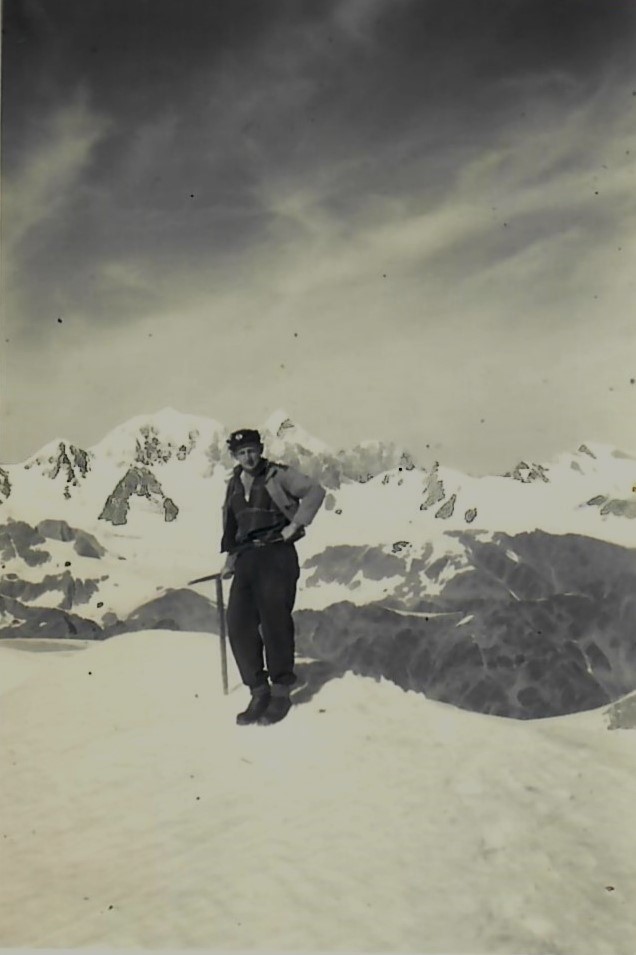
Peter McCormack, 12 December 1922 – 7 April 2018
Peter McCormack, aged 29, was a third generation West Coaster. His father and grandfather were gold miners. The McCormack family initially lived on a gold-mining claim at Gillespies Beach, near Fox Glacier but Peter mainly grew up in Franz Josef/ Waiao, where his father worked sporadically as a barman but spent most of his time gold prospecting unsuccessfully up the Callery and Waiho rivers. His mother worked in the hotel kitchen to support the family. Peter worked as a farmhand in Franz Josef, then enlisted for WWII and did his training in Blenheim, only to be manpowered home as farming was an essential industry. He worked on the farm owned by the Grahams, who also had the Glacier Hotel, and who introduced him to mountaineering. He started guiding on Franz Josef in 1946.
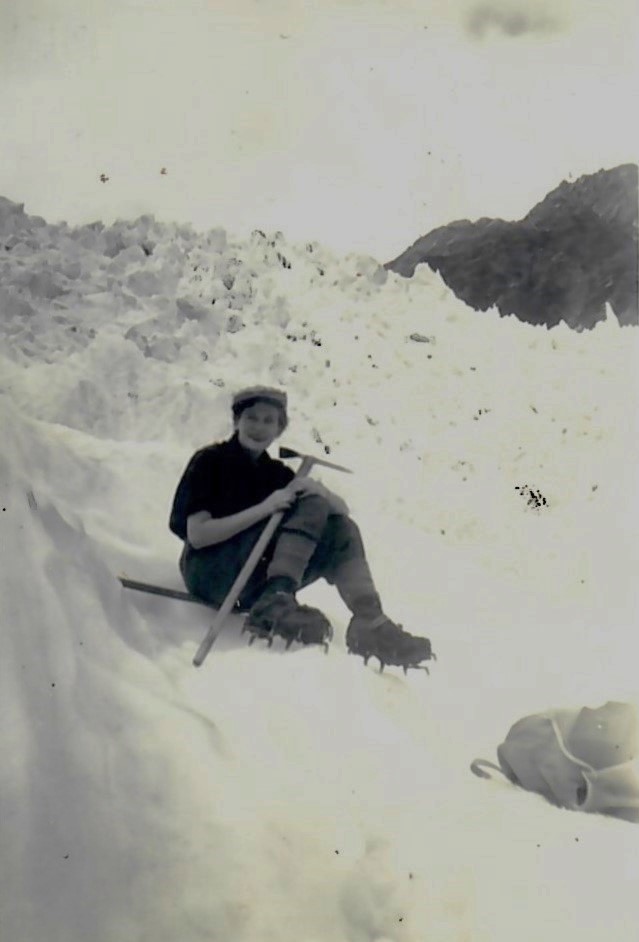
Ena Joy McDonald, 21 January 1924 – 10 December 2000
Ena McDonald, my mother, aged 28, was born on a farm in Waipipi, on the Awhitu Peninsular. She attended Waipipi School and Epsom Girl’s Grammar. At age 15, she studied typing and bookkeeping at Brain’s Commercial College in Auckland. She moved to Christchurch in the late 1940s and joined the staff of the Registrar of Canterbury University College. She often went to the Hermitage at Mt Cook for the weekend and it was here that she developed a love of the mountains and learnt a little about alpine climbing. In April 1952, she planned to cross the Graham Saddle for the first time, with guide Peter McCormack.
The incident
On Friday 11th April 1952, in the early hours of the morning, Roy Beedham and Gerald Brooks secretly left the Fox Glacier Hostel intending to cross the Southern Alps to The Hermitage via the Graham Saddle. They were inexperienced climbers and had been advised against the venture, however they set off regardless. En route to the Almer Hut via the Franz Josef glacier, they encountered Harry Ayres and his party. He advised them against crossing the Graham Saddle because he was concerned about both their lack of appropriate equipment and suitable clothing, as well as their evident inexperience in alpine climbing. They proceeded, nonetheless.
On Wednesday 16th April, Peter McCormack, was guiding Mum, with the intention to cross the Graham Saddle. They had climbed Mount Moltke and stayed a night at Defiance Hut. The following day, they crossed the Franz Josef glacier intending to spend the night in the Almer Hut. When they got to the hut, they found the door snibbed from the inside and muffled sounds emanating from within. Their attempts to break into the hut roused the inhabitant and they discovered Roy, seemingly delirious, bruised, gaunt and with frostbitten feet. He gave a confused account of an accident on the Rudolf Glacier, on the Eastern side of Graham Saddle and told them that his companion, Gerald, was dead.
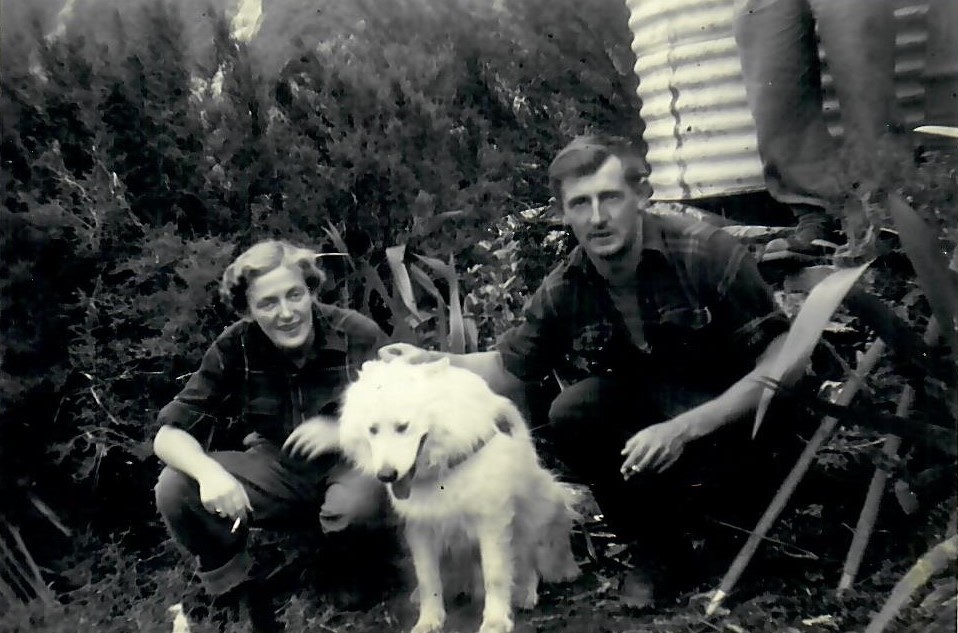
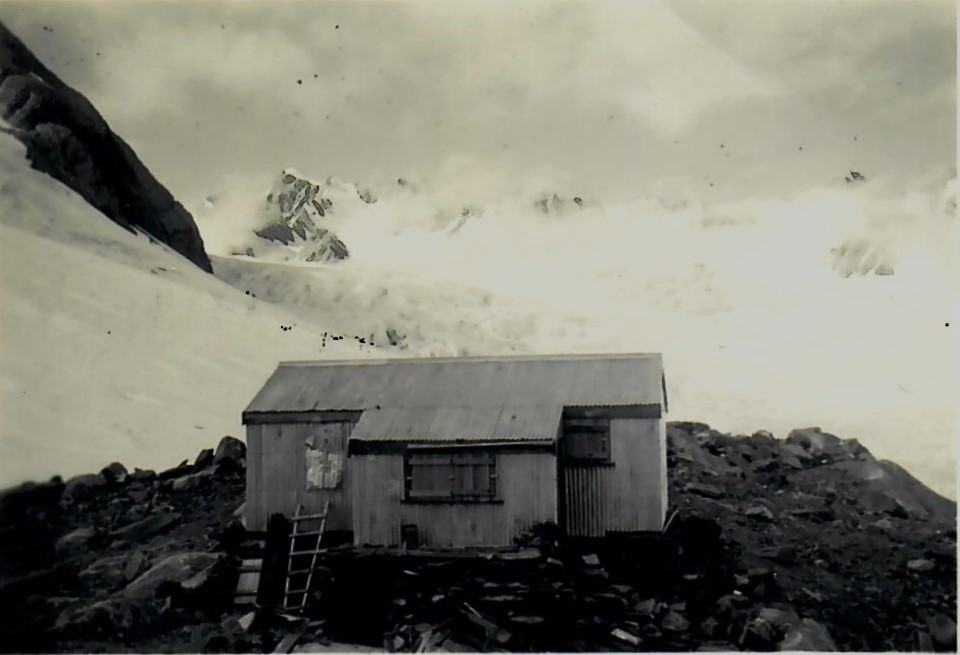
It was agreed that Mum would remain overnight in the hut with Roy, while Peter returned to the Franz Josef hostel to raise a rescue party, making the descent in an hour and a half – a record time. A party was dispatched from the Franz Josef hostel and another from the Hermitage, with a third setting off from Timaru. Mum often recalled how afraid she had been during that night. She bathed Roy’s feet with warm water and worried for years after that she had done the wrong thing. He wouldn’t eat, and she tried to encourage him to drink water. In the middle of the night, she went outside to escape his moaning and raving.
Roy’s initial account was that Gerald slipped on the glacier face and fell. Roy climbed down the glacier in an attempt to rescue him but upon seeing him dead, climbed back up and made his way to the Almer Hut on the West Coast side of the pass, where he was discovered by Mum and Peter and the rescue operation was initiated by Peter.
Early on the morning of Thursday 17th, a party of 22 volunteers left the Franz Josef Hostel, accompanied by Dr J Horan of Whataroa. They made the ascent to the hut in three and a half hours, another record time. Roy was transported on a stretcher by relays of rescuers, back down to the Franz Josef Hostel. Roy was a big man, and the ice ridges were steep, at times making progress with the stretcher impossible. Roy had to be unloaded, double-roped, and helped to walk across the ice.
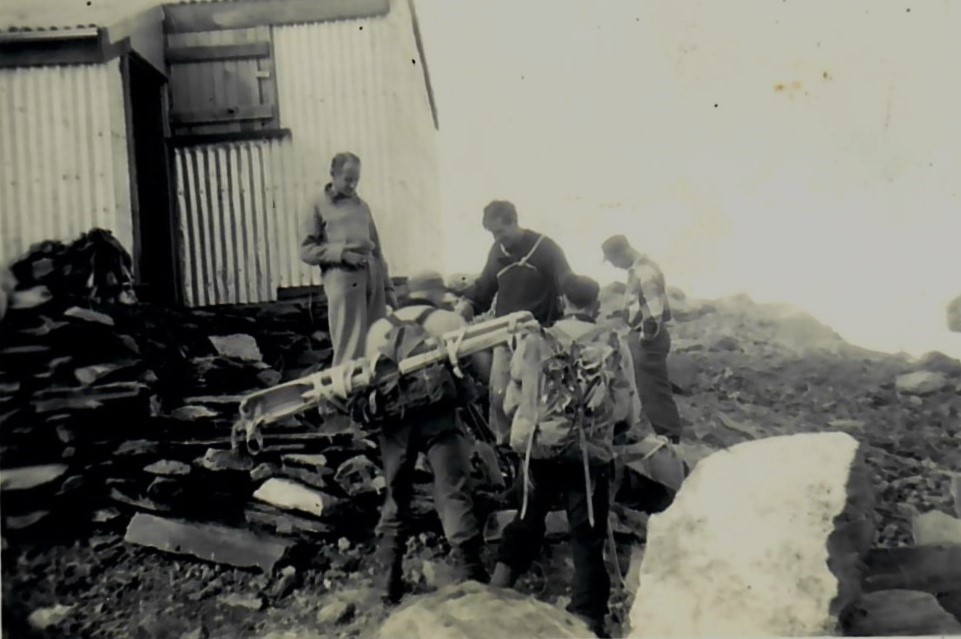
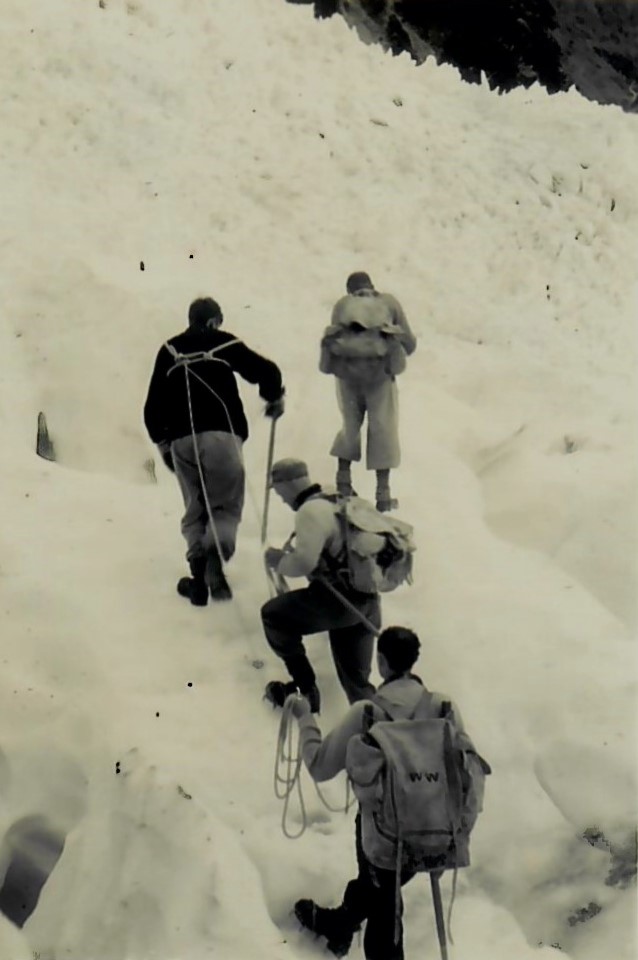
Gerald’s body was recovered from the Rudolf Glacier on the afternoon of Thursday 17th by a rescue party from The Hermitage. Ice and snow conditions were so treacherous that it took 11 hours for the search party to reach the head of the glacier, where Gerald’s body was found half buried in the snow. Due to the conditions on the ice, it took the rescue parties, consisting of at least 24 men, two days to recover the body and bring it to the Hermitage.
At the coroner’s inquest in early July, Roy testified that on Friday 11th April, he and Gerald travelled by road from the Fox Glacier Hostel to Franz Josef. They then climbed up the glacier arriving at the Almer Hut in the early evening. They were delayed by bad weather and did not leave the hut until early Sunday morning, when they set off to cross the Graham Saddle and continue on to De la Beche Hut. Roy claimed no recall of Harry Ayres advising them against the venture. As they commenced the descent on the eastern side of the saddle, they encountered dangerous weather. Gerald slipped on the icy slope, knocking Roy off his feet and they both slid down several hundred feet. They built an ice cave to shelter from the wind and snow. Gerald, who had been injured in the fall, became delirious and wandered out of the cave. The heavy snowfall prevented Roy from following. Roy became snowed in and the next morning he dug himself out and attempted to search for Gerald. He believed he had seen his body about 700 feet down the slope. He returned to the Almer Hut where he stayed until Mum and Peter arrived the following day.
Witnesses, including Harry Ayres, testified that both Roy and Gerald appeared to be “complete novices” on the mountain and that they were unsuitably clothed for the conditions. The coroner described the incident as a foolhardy adventure which should not have been undertaken.
Afterwards
Harry
Harry Ayres was a member of the New Zealand party of the Trans Antarctic Expedition from late 1956 to early ’58. On his return, he was appointed Chief Ranger of the Mt Cook National Park Board, a position he held until 1961, when he went to run a motor camp at Hanmer Springs. In 1972 he moved to Christchurch, where he was the gardener at the historic Mona Vale estate until his retirement in 1982. He was awarded an OBE in 1981. In July 1987, Harry drowned in Lyttleton Harbour. He was survived by his wife, Jean, and their three children.
Roy
Roy continued to climb in the Alps. On 11th January 1953, he, along with companion Stuart Holmes, made the first successful ascent of the Coxcomb Ridge on Mt Aspiring/Titetea. Later that year he was reported as missing in the Mount Aspiring area but turned up again three weeks later.
In January 1954, Roy, now aged 24 (but recorded by the Press as 28), was again reported missing while attempting to cross the Copland Pass from the Unwin Hut below Mt Cook/Aoraki to the West Coast. However, on 10th January, it is recorded that he met another climber, Roger Evans, at the Hermitage, and on the 17th they left and successfully climbed Malte Brun (10,421ft). Two days later they attempted to climb Mt Elie de Beaumont with another companion in bad weather. Evans fell while attempting to rope down a rock face on his own and was killed. Roy made a valiant but unsuccessful attempt to rescue Roger. An inquest in May found that Roger died when he fell into a bergschrund on the Anna Glacier.
In February 1959, Roy was once again reported missing in the Alps. Now aged 28 (but reported as 34), he and a companion, George Broadbent, had set off from the Haast Hut, intending to climb Mt Malaspina at the head of the Linda glacier. They had indicated in the diary at the hut that they intended to return the same day and had left a jelly to set. The weather had deteriorated and, five days later, a search party found no trace of the two men.
It was thought that the pair were so keen to climb Mt Malaspina that they had overlooked the danger of traversing the Linda Glacier route. It was well known that they were keen to complete the 24 10,000ft peaks before the end of the season. They had already climbed 20 at the time of their death.
In October, the Coroner concluded that Roy and his partner had met their deaths on or about 18th February after they failed to return from the climbing trip. He noted that both men were experienced climbers who had met their deaths in an extremely dangerous area.
Gerald
Gerald was buried in the Timaru cemetery on 22nd April 1952.
Peter
Peter was a highly respected guide on the Franz Josef Glacier for over thirty years, until his retirement in 1982, when he was awarded the Queen’s Service Medal for public services. In retirement, he travelled to the mountains of Switzerland and Canada; however, his heart was always in Franz Josef. Peter died in April 2018, aged 95, the year after his wife Elizabeth. They were survived by their two daughters, Trish and Annie.
Ena
On her return to Christchurch, Mum joined the nursing division of the St John’s Ambulance Brigade where she served until 1955. She continued to enjoy hiking in the Southern Alps and had a love of the mountains all her life.
While attending the ice-skating rink in Christchurch in her role as a St John’s nurse, she met George Myles, a Scotsman serving in the NZRAF and based at Wigram. Following their marriage in October 1955, she left the university and together they travelled to the UK and Europe for eighteen months. On their return to NZ in 1957, they settled in Manurewa, South Auckland, where they raised two daughters, sally (me) and Mandy. They remained in Manurewa until Mum’s death in December 2000.
In later years Mum fulfilled her sense of adventure through travel. She first acquired a taste for it in the 1940s, when she flew to Sydney to visit a cousin, on the Solent flying boat. After Dad joined TEAL (later Air New Zealand) in 1957, they frequently travelled together when Mum accompanied Dad to his IATA meetings, starting with a trip to Greece in 1964. Later she and Dad had many travel adventures together, including on the Trans-Siberian Railway, walking on the Great Wall in China and visiting the Iguazu Falls in Brazil.
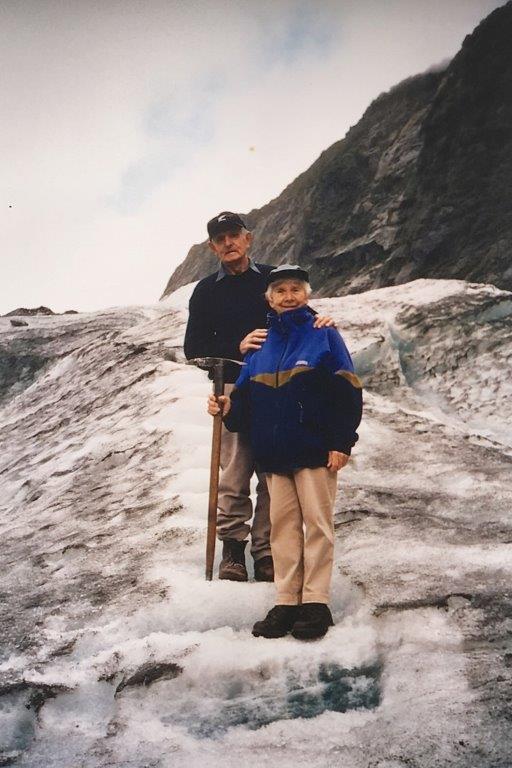
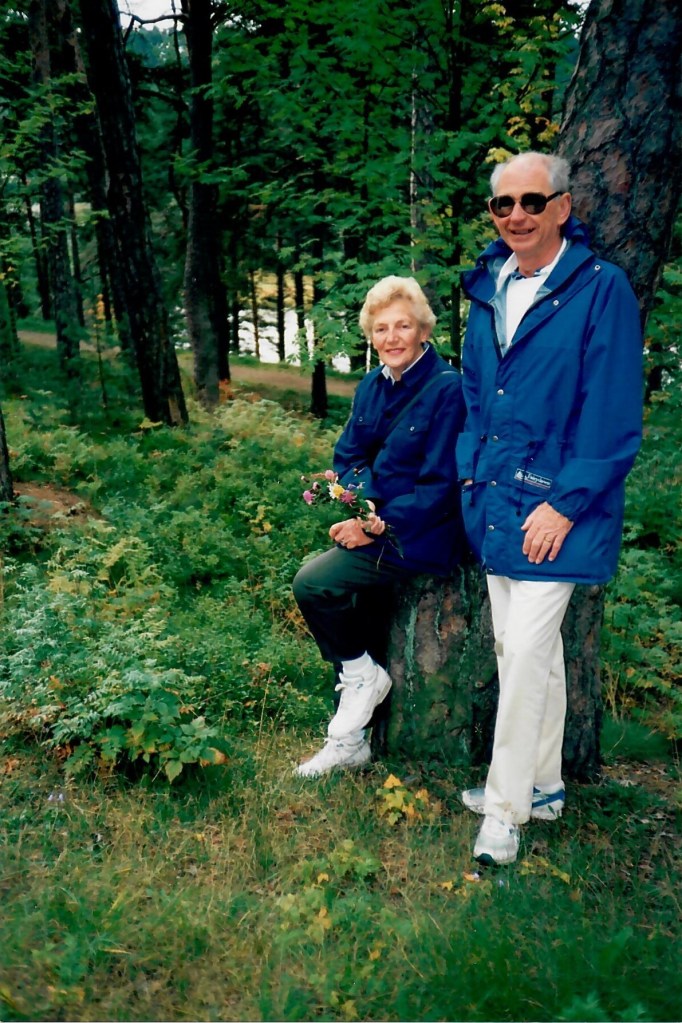
In 1994, Mum and Dad, along with Dad’s sister Tricia from Edinburgh, visited Peter McCormack and his wife, Elizabeth, at their home in Franz Josef. Peter and Elizabeth later published a recollection in the Friends of South Westland Mountaineering newsletter no. 4, November 1994.
Postscript
Thinking about Mum’s recollections of the accident and flicking through her photo albums and the old newspaper clippings, I got the idea into my head that I would like to visit the Franz Josef glacier and maybe stay a night in the Almer Hut. I hasten to add that I have never visited a glacier nor spent a night in a tramping hut in my life. When my husband, Peter, and I were planning a road trip to the South Island in March 2023, I emailed the Department of Conservation to enquire what level of fitness might be needed to access the hut. I explained the circumstances surrounding my interest in the hut and pointed out that Mum had been 28 and quite fit at the time, whereas I am 65 and, while moderately fit, inexperienced in any kind of alpine activity.
Christina from DoC responded that, Almer Hut can only be accessed via helicopter. The glacier has receded so far, that unlike Mum you are not able to climb or walk to the hut. I thought that might be the end of it, but Peter encouraged me to contact one of the helicopter companies and we started to make plans.
We booked our journey with HeliServices and sought advice from Christina about what we should bring. She advised that for an overnight stay at Almer Hut we would need a camping stove for boiling water and cooking, food supplies, a sleeping bag and appropriate clothing. We could expect it to be around 10-15 degrees cooler at the hut than in the town. Due to ferry cancellations, the hut booking was moved to the end of March, and we threw a couple of extra layers into the case, including puffer jackets borrowed from a friend, for which we were very grateful.
We arrived in Franz Josef/Waiau on the afternoon of Tuesday 28th March, checked with HeliServices that everything was on schedule for the following day, and visited Christina at DoC to pay our hut fee. The following afternoon we checked into HeliServices where they weighed us and our bags, helped us climb into the helicopter and we took off for the ten-minute flight to the hut. It was my first time in a helicopter, but I found it was not much different to flying in a light aircraft, except that the helicopter does tend to fly quite close to the valley edges. I wondered if that was to reduce the impact of the wind or simply for scenic effect? If the latter, I didn’t feel it was necessary.
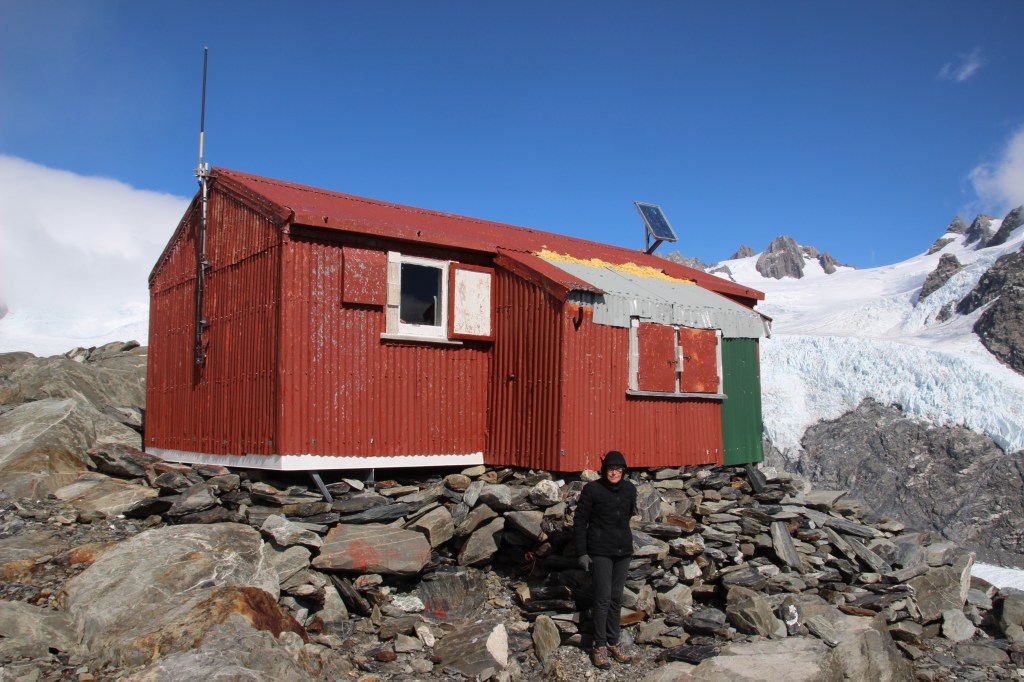
The landing spot for the helicopter was indicated by a letter H constructed from white stones laid on a small flat space about 3m x 5m, about 100m from the hut. We were bundled out and made our way across the schist to the hut. It was a little alarming to find ourselves alone on a mountain for the night. Once we went into the hut, we realised we would not be alone as there were packs and sleeping bags on the bunks in the main room. We put our packs in the second room and sat on a rock outside in the afternoon sun to enjoy the scenery and calm ourselves a little. Around half past three, our hut companions, a climbing party of four, appeared. They had been staying in the hut since Monday and were Franz Josef locals as well as experienced climbers. Also experienced in alpine huts, which was useful for us.
We introduced ourselves, chatted a while and boiled hot water for a drink. Then we heard the whir of helicopter blades and were surprised to be joined by another party of four. A young person from the far north and their companions, travellers from around the globe, who were all working in hospitality at Franz Josef. The first four, who had been planning to leave in the morning anyway, decided to depart this afternoon and leave us all with a bit more room. They called the helicopter company to collect them.
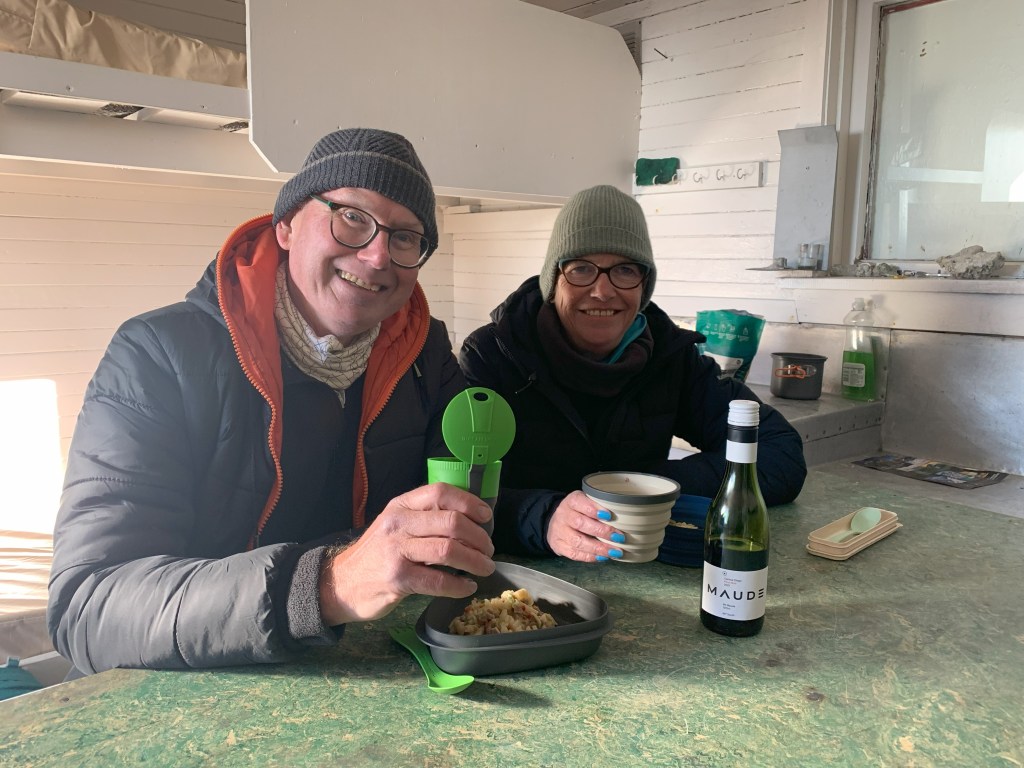
The six of us remaining began to settle in for our evening. Peter and I boiled some water and rehydrated our pasta. We toasted mum and Peter McCormack with a half bottle of Maude pinot noir. It had seemed like a good idea at the time to take a red wine, however I had not factored in that by the time we were drinking it, it was quite chilled.
As the sun dropped, it became increasingly cold, and I added layers of clothing until it was quite difficult to move. When the sun set, I climbed into my sleeping bag wearing four layers of merino, a merino outer jacket, a neck scruff, two woolly hats, gloves, and a puffer jacket with hood. On my feet I had two pairs of thick socks and felt slippers. I was glad that my sleeping bag also had a hood. I slept surprisingly well, however I did wake at around 1.30am feeling very cold and stiff. I was completely unable to move inside the sleeping bag and I had to waken Peter to sit me up so that I could wriggle my legs and feet a bit. Now that we were fully awake, I decided it might be wise to make the treacherous journey to the toilet hut some 50 meters away across the rocks. Surprisingly, it felt slightly warmer out of the hut than in. It was a real treat to see the clear night sky and if it had been somewhat warmer, I would have enjoyed sitting out to take in all the constellations.
We slept through until just before seven. When I opened the door of the hut and saw the daylight outside, it was easy to imagine Mum’s relief when, in April 1952, she would have opened the hut door to the realisation that help would not be far away. We rehydrated our muesli and yoghurt and had a warm cup of coffee. Our companions of the night before had decided to be flown out somewhat earlier than planned and they left us around 8.00am. It was another lovely day, and Peter and I sat outside and enjoyed our surroundings. We were joined for a while by a kea, who was good company although probably disappointed that we did not have anything of value to share.
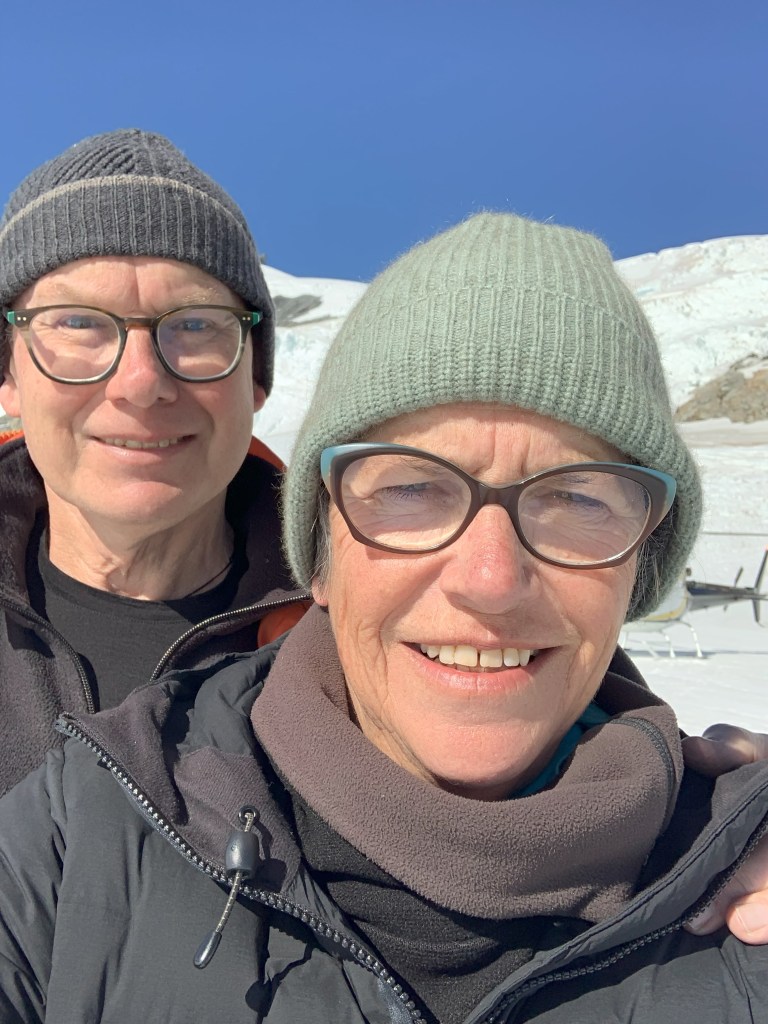
The helicopter that came to collect us was taking another couple on a scenic flight, so we had a bonus flight across to Fox glacier where we landed and were able to have a short walk on the snow field. The scale of the landscape is awe-inspiring, and it is easy to appreciate how people like Mum would develop a lifelong passion for the mountains.
I am so pleased to have had this experience and I hope future generations in our family will also visit, to stand in Mum’s footprints.
Other stuff you might find interesting
Man killed on glacier. Injured companion safe, The Press 17 April 1952, p6
Man’s death on glacier. Searchers leave to recover body, The Press 18 April 1952, p6
Man’s death on glacier. Body recovered yesterday, The Press 19 April 1952, p6
Man’s death on glacier. Attempt to cross the Southern Alps a foolhardy adventure, The Press 2 July 1952, p8
The Graham Saddle Accident, NZ Alpine Journal, no 39, 1952 p377-378
The Graham Saddle Fatality, NZ Alpine Journal, no.40 p301-302
English climber missing. Attempt to cross Copland Pass, The Press 7 January 1954, p8
Man believed killed. Fall on Mt Elie de Beaumont, The Press 22 January 1954, p10
Climber’s death near Mt Cook. Inquest at Fairlie, The Press 1 May 1954, p8
First aid in the mountains. Christchurch girl’s experience, The Press 10 September 1955, p2
Two missing in Alps. Little hope held for survival, The Press 28 February 1959, p12
Two missing climbers. Men now thought to be dead, The Press 4 March 1959, p12
Climbers killed in Alps. Coroner returns verdict, The Press 14 October 1959, p16
Advertisements, The Press 24 June 1976, p27
Intrepid climbers put their marks on all the 3,000m peaks, The Press 26 May 1977, p17
Obituary, The Press 9 April 2018
Franz Joseph Mountain Guide Peter McCormack. West Coast New Zealand History. https://westcoast.recollect.co.nz/nodes/view/22221
Peter McCormack, mountain guide on Franz Josef glacier.1958. West Coast New Zealand History. https://westcoast.recollect.co.nz/nodes/view/22304
Peter McCormack mountain guide – obituary. West Coast New Zealand History. https://westcoast.recollect.co.nz/nodes/view/23258
ClimbNZ, Coxcomb Ridge, https://climbnz.org.nz/nz/si/aspiring/main-divide/mt-aspiring-tititea/coxcomb-ridge
 Our Folk Stories