In every family tree there are surprises. My mother, Betty, was fond of relating how one of her ancestors was called de Montmorency and who perhaps was a lady-in-waiting to Queen Victoria. The name sounded aristocratic and although my grandparents, Betty’s parents, lived in a pleasant semi-detached house not far from the river Thames, it was no stately home. Their Ford Consul was hardly a Rolls Royce and there were scant symbols of ostentatious wealth, barring the portrait of a great great-grandfather (on my grandmother’s side) in a stationmaster’s uniform and a preserved tarantula, fondly called George, hanging from the dining room picture rail.
Yet my great great-grandmother was indeed Harriette Maria de Montmorency. It might be supposed that Harriette descended from a family of the French nobility. Montmorency is one of France’s oldest and most prestigious noble families, hailing from the town of that name just north of Paris. How the name came to be associated to our ancestors is an intriguing story. Before exploring that and Harriette’s ancestry, in another post, let me explain how I am descended from her.
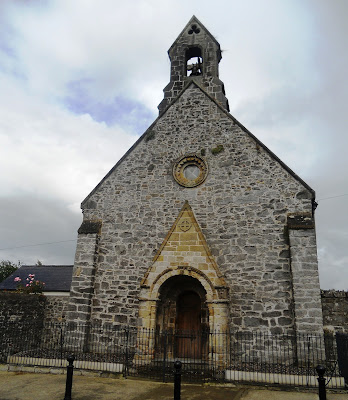
Harriette was born in County Kilkenny, Ireland, around 1849. Her parents were William Ryves de Montmorency and Mary Proctor. William was the second youngest of eight in his family, though four of his older siblings died before he was married, two in infancy. His family was landed, of “Old English” (descendants of the Anglo-Norman 12th century invaders of Ireland) ancestry, and had converted to Protestantism.
Harriette was the third child of eight in William and Mary’s family. The decade of her birth were hard, indeed desperate, times for many in Ireland, in the wake of the Great Famine of the earlier 1840s, but Harriette’s family was well connected and hence protected from the worst of the catastrophe. Harriette was born in the family’s manor house, Mount Eland, in the township of Grange, near Ballyragget, a town about 20km north of Kilkenny in the Irish province of Leinster. The house had been the home of the family of Eland Mossom in the 18th century. The Mossom and de Montmorency families were connected through marriage but it is not clear how the house came to be in William’s hands.
Despite the family’s relative security, an opportunity to escape the country’s problems would have been welcome. Harriette’s oldest sister, Jane, six years her senior, emigrated to Wellington, New Zealand where she married another British émigré, James Wrigglesworth. Their story is both interesting and tragic, but will be told elsewhere. Three brothers and a sister, Robert, Elmrick, George and Louisa, all emigrated to the area of Oxford, Ontario, Canada, where they established farms and families. One other brother, Alfred, died in childhood.
On 21 January 1871, Harriette married Richard James Claridge in the church of Aghour (Freshford), Co Kilkenny and her father was one of the witnesses. Richard had been born in 1847 in Prees, a Shropshire village close to the Welsh border. He became an excise officer for the British government and must have been sent to work in Ireland, at that time a part of the United Kingdom. Richard was 23 and Harriette 21 when they wed.
Harriette and Richard, it seems, soon moved to England, for the first of their five children, Alfred, was born in Clitheroe, Lancashire in 1872. Thereafter came John in 1873 and Ellen Edmondson Claridge, my great grandmother, in 1875. Ellen was named after her paternal grandmother Ellen Edmondson. Richard was posted to a new inland revenue office in Grimsby, Lincolnshire. The family moved east to nearby Caistor, where two further children, Mary Beatrice (1880) and Richard De Montmorency (1884), were born. In 1881, Ellen was living with her siblings, a cousin, her mother Harriette, and grandmother, Ellen, in Warton, Lancashire. In the 1891 census, the family is living at 112 Scalpcliffe Road in Stapenhill, Burton-on-Trent, Staffordshire. Ellen is described as a dressmaker’s apprentice. Her father, Richard, is still an inland revenue excise officer. Incidentally, Harriette’s final sibling, William, also moved to Lancashire, so none of William and Mary’s children stayed in Ireland. Their father, William, died at home in Mount Eland in 1887 and their mother, Mary, in nearby Urlingford the following year.
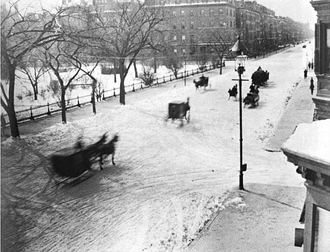
In January 1897, Ellen, known as Nell, married Philip Charles Hunter in Leeds, Yorkshire. Philip’s Hunter ancestors were originally from Dumfries in Scotland but had moved south to Bristol, where Philip was born in 1875 and the family were members of the non-conformist congregation there. They had established themselves as drapers and tailors. Philip, at age 16, had been employed as a clerk at a woollen warehouse in London. After the birth of Ellen and Philip’s first two children, Philip James (1897) and Hubert Wallace (1898), their father sailed with his older brother, Arthur, to New York in December 1898. It seems they established a wool and cloth trade across the Atlantic. The following year, on 1st June, Ellen, together with the young Philip and Hubert, aged just 2 and 11 months, respectively, sailed from Liverpool on the SS Canada to join her husband in the States. They arrived in Boston on 9th June and barely two weeks later, Ellen and Philip’s third son, Clive Charles Hunter, was born at Gay Street in the Boston suburb of Newton.
The family stayed in Boston for some time. In July 1902, Ellen gave birth prematurely to a daughter, Beatrice, who sadly died after just a few days. In 1903, Philip was listed in the Newton city directory as living on Gay Street and earning a living as a salesman. However, in 1905 he was listed as removed from the city. In May 1907, their last child, Charles Richard, was born in Lichfield, Staffordshire. Clearly Ellen had by now returned to the UK, while in July of the same year Philip appears on the passenger list of the liner New York, returning from New York to Plymouth. Then, in January 1909, Philip returns to the United States. He is listed as single (presumably divorced), a woollen merchant. In 1913, the Boston city directory includes him as a woollen merchant operating from the same location of 8 Beacon St, the main thoroughfare through Boston to Newton. In 1912, Philip married Marguerite Kelsey and they had a son, Philip Edward. On 17 December 1914, Philip Charles died of septicaemia, in Boston.
Ellen’s surviving children, Philip, Hubert, Clive and Charles were living with her, in Lichfield in 1911. Harriette and Richard had also moved to Lichfield, Richard by then retired. Clive sang in the choir at Lichfield cathedral. Clive, still only 14 years old, been signed up to the Royal Field Artillery in April 1914. In February 1915, Richard died, leaving his small legacy of to his widow. Ellen also remarried in 1915, to Frank Whalley. Ellen’s three oldest sons all enlisted for active service in the First World War.
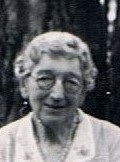
Hubert emigrated to Canada in 1929 and Philip, in the early 1930s, to New Zealand, where he had been seconded to the navy from the British navy and was stationed on the HMNZS Veronica, visiting Napier when the terrible earthquake of 1931 occurred. Clive and Charles remained in England. All married – Hubert to Daisy Collard and Clive to her cousin, Constance Jearum. All had one or more children. Harriette herself moved to Brighton where she boarded at a house in Bristol Gardens. In the 1921 census, she was resident there with her visiting daughter Mary and her husband Henry Wilkins, also an excise officer like Harriette’s husband. Harriette died in March 1929. Ellen and Frank remained in Lichfield until Nell’s death in 1952, Frank surviving just a year longer. Ellen’s granddaughter, my mother, remembered her and “Uncle” Frank with great warmth.
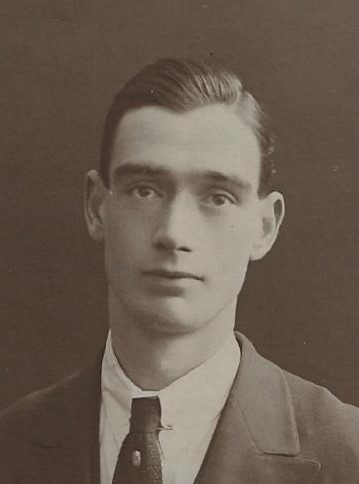
Here follows a very brief and partial account of the recent generations of our family. My grandfather Clive married Constance Alexandra Jearum on 15th March 1922. They lived on The Parade in Mitcham, Surrey. Clive was a tailor, following in the Hunter family tradition. Later, Clive and Constance both worked at Teddington Controls (formerly the British Thermostat Company) in Sunbury-on-Thames. Their two children were my mother, Betty Patricia, born in January 1925, and her younger brother Peter Darol, born in October 1933. Peter also later worked at Teddington Controls.
Betty married Gerald Anthony Donelan in Sunbury in 1947, and they lived at the home my paternal grandmother, Susannah (nee Hargreaves) had bought, leasehold but brand new, in Beckway Road, Streatham Vale in 1926. My brother Michael was born in 1951, and I was born four years later. Constance died in 1969 and Clive, after remarrying in 1970, also died a few months later. After Betty was widowed in 1976, she remained in Beckway Road until she was in her 80s. She had taken a job as secretary to the Patents Officer at the local United Gas Industries (formerly Smith Meters) factory in the neighbourhood. Coincidentally, UGI had recently merged with the British Thermostat Group. Betty’s last years were spent in Saffron Walden and she died there in 2017, just a few months after her beloved younger brother, Peter.

